
Click on image for full picture
 A different look at the country Russia, divided into regions by this birding website with the following description, "There are a bewildering array of regions, districts, autonomous regions, city districts and opther political subdivisions in Russia. Rather than dedicate a birding page to each we have chosen to split the huge landmass into several super-regions which have similar climates, avifaunal habitats and so forth. Graphic from http://www.fatbirder.com/links_geo/europe/russia.html
Far East Russia is essentially wild and sparsely populated land. And in the country's recent dark past regarding internal oppression 1930s-1940s), the communist leader Joseph Stalin used Siberia and Far East Russia as a convenient place to send individuals (by the millions) who were a perceived threat to the communist ideology, though more precisely, his growing personal power.
Labor camps throughout this cold distant land - made famous in Aleksandr Solzhenitsyn's books "The Gulag Archipelago," and "One Day in the Life of Ivan Denisovich" - were both the source for probably mindless work projects as well as the sites representing the end of life for millions of unfortunate Russian and Soviet Empire citizens. The particular section of highway in the graphic below was denoted the "road of bones" due to the practice of burying workers who had died constructing the road, in the roadway itself.
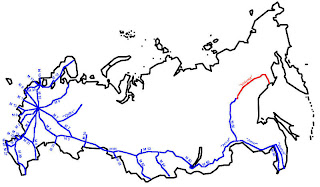 Officially known as the Kolyma Highway - the section in red - it is also known as the "road of bones." From Wikipedia, "It was constructed in the Joseph Stalin era of the USSR by Dalstroy construction directorate. The first stretch was built by the inmates of the Sevvostlag labor camp in 1932. The construction continued (by inmates of gulag camps) until 1953. The road is treated as a memorial, because the bones of the people who died while constructing it were laid beneath or around the road. The land there is permanently frozen so interment into the fabric of the road was deemed more practical than digging into the permafrost to bury the bodies of the dead."
 Click on image for full picture
 An icy bridge on the Road of Bones. Photo by CompassExpeditions.com.
Now in 2014, the highway remains dilapidated by modern standards, though in its defense, the land is so cold for much of the year, and so desolate, that ice roads can be built quickly and practically used for much of the year, without investing efforts and funds to build a paved roadway to modern standards.
Click on image for full picture
 One of the colder places on earth - from Yakutzk to Magadan. Photo from askyakutia.com
 Rather than build a major bridge to replace this relic, an ice road over the frozen river will suffice for nearly half the year, and for a couple months, six-wheel drive trucks can wade through the water except during the spring runoff. Photo from http://karakullake.blogspot.com
.jpg) Hardy, or perhaps foolhardy, passenger vehicles link up with truck convoys during the brief season when the roads are not frozen ... Photo from the-bblue.blogspot.com
Hardy, or perhaps foolhardy, passenger vehicles link up with truck convoys during the brief season when the roads are not frozen ... Photo from the-bblue.blogspot.com Click on image for full picture
 The end point of this treacherous road from Yakutsk is the Russian town of Magadan, population just under 100,000. Photo from www.trekearth.com
Monuments
A haunting memorial was built along the highway nearing Magadan. It commemorates all those who died building the highway and the circumstances that led them to these ill fated labor camps.
Click on image for full picture
 Despite some effort searching for the details of this monument (when, by whom, etc) not much has emerged. See figure at the bottom of the memorial to get a sense of size. Photo from http://caravanchronicles.com
An even more bewildering monument - at least in terms of "why" - is one in the town of Magadan itself. There are a few folks apparently still enamored with Stalin, just as there are those with Hitler. (Or those, for that matter, who deny the Holocaust ever occurred.)
 A new statue of Stalin, erected in May 2013, was financed by the “Almazy Anabara” diamond-mining company and supported by its company’s president Matvei Evseev, who is a member of the United Russia party. Photo and article by Bolot Bochkarev, a journalist, fixer & guide based in Yakutsk, Russia His website is http://askyakutia.com/tag/road-of-bones/

2 comments:
For another fascinating travelogue about Siberia (if "Long Way Round" wasn't enough), I really enjoyed "Travels in Siberia" by Ian Frazier. One image that sticks with me from the book is the graveyards of abandoned Soviet-era military/industrial vehicles and machinery along stretches of road. The audio book is great for commutes on uninteresting and dubiously-maintained Connecticut highways.
fascinating! I'm putting the movie and the book on my lists! Perhaps the audio version will make it into the car that headed south on dubious Oregon roads every day...
Post a Comment