Lots of issues out there - the ongoing Yemen conflict, a new President elected in Somalia, Syria's continued bloodletting, the newest projection of when Iran might get a nuclear bomb, etc.
But a trend perhaps more newsworthy is the growing series of tensions over islands between Asian neighbors. Most, but not all have to do with China and its robust claims to a variety of island chains. The latest is a spat between Japan and China.
The Christian Science Monitor seems to be covering the story quite comprehensively, so much of the following comes from that news source.
The dispute, the article begins, between China and Japan is over the
Senkaku Islands, five islets and three rocky outcroppings, and revolves around who got there first. China calls them the
Diaoyu Islands and dates its authority there to the 14th century. Japan annexed them in 1895 after finding them uninhabited.
Japan's foreign ministry cites surveys in 1885 confirming they were "uninhabited" with "no trace of having been under the control of China." The government of Japan in January 1895 decided to incorporate the islands and to place a marker on one of them declaring them to be part of Japan. On the other hand, the Chinese claim that the islands appear on Ming Dynasty maps.
Click on image for full picture
The Senkaku islands - as Japan names them, or the Diaoyu islands according to the Chinese - are at the center of this latest tension.
We might first jump back to the aftermath of World War II when Japan was a defeated nation, and China was in the latter stages of a civil war between Mao's forces and those of the Nationalist government. US forces had driven the Japanese from the island prefecture of Okinawa in June 1945 in one of the last Pacific island battles of World War II. The islands, 220 miles southwest of Okinawa, had been governed by Okinawa under the Japanese.
As de facto holders of a variety of islands and territories after the end of the war, apparently neither the Communist government on the mainland nor the "Nationalist" Chinese government having retreating to the island province of Taiwan, objected when the San Francisco Peace Treaty of 1951 placed the islands under US administrative control.
The two Chinese governments - in Beijing and Taiwan - got interested in 1970 after a United Nations study showed there might be oil and gas in the seabed around the islands. The island cluster is 76 miles from Taiwan, 92 miles from the closest Japanese island, and 100 miles from the coast of China.
Oil and gas fields that are becoming increasingly viable for drilling may have something to do with the current escalation of tensions
Japan regained governing control in 1972 under the "reversion" of Okinawa to Japan. Since then, Japanese Coast Guard boats have been on regular patrol to prevent intrusion, mostly by Chinese fishing boats.
The original official "owner" was a Japanese man who set up a fish plant in the late 1800s, employing about 200 workers in the factory. The business survived for 50 years but finally failed in 1940 while Japanese forces were reigning supreme over much of China, the Korean Peninsula, and Southeast Asia more than a year before bombing Pearl Harbor. His family sold the islands to another Japanese family, and up to the present time, this new Kurihara family has been leasing the islands to the Japanese government.
Jumping forward to today, the islands are covered by jungle. There are no rivers, and fresh water from rainfall is at a premium. Certain wildlife exists, including rare species of moles and ants, however small goats, introduced more than 30 years ago, have multiplied and become a threat to vegetation.
Not much on these islands themselves
Apparently a proposal from Tokyo Governor Shintaro Ishihara to buy the islands from the Kurihara family for the capital city's ownership was made - a gesture that not only upset the Chinese, but the Japanese government as well. And it is not just mainland China in this case who has its hackles raised. China and Taiwan are equally adamant about the Chinese claim to the islands. Nevertheless, the Japanese government on Tuesday, in order to clarify ownership - NOT to end disputed claims of sovereignty - signed a contract with the Kurihara family, the private owner of the islands.
While in this case, it appears Japan has brought forward an action that has upset an uneasy but quiet status quo, China has much of South Asia in a buzz over its own expansive claims of ownership further to the south. And China's anger over the Japanese purchase has resulted in Chinese patrol ships being sent to the islands waters - not exactly a cooling-of-tensions type of move.
Click on image for full picture
For further reading the Christian Science Monitor has an article titled, "Top 5 East Asia island disputes" at
http://www.csmonitor.com/World/Asia-Pacific/2011/0803/East-Asia-s-top-5-island-disputes/Takeshima-Dokdo-islands-claimed-by-Japan-and-South-Korea
 This graphic shows a growing number of protests in Vietnam against the Chinese. While the graphic shows 3 such protests, the latest is that there have been incidents in over 22 provinces of Vietnam's 63. From www.straitstimes.com
 While protests were at first orderly, such as this one in front of a Chinese owned factory in the Thai Binh province further north, others became violent causing property damage, injuries and deaths ... photo from www.nytimes.com
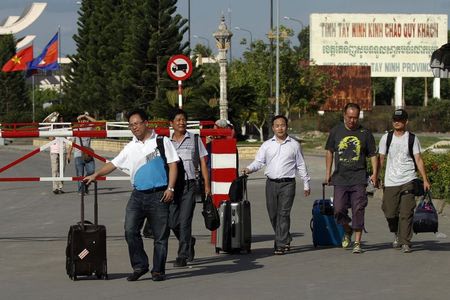 Chinese nationals queuing to leave Vietnam. photo from www.newslocker.com
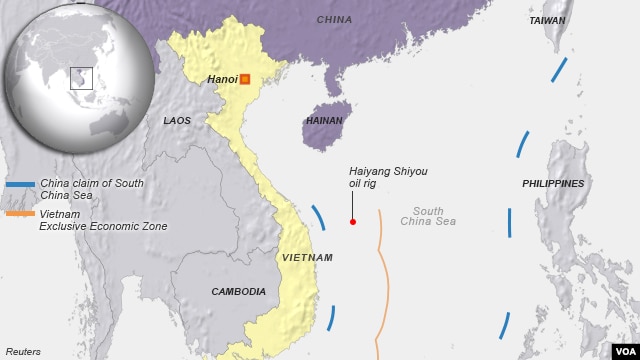 The oil rig placed by China renews the conflicting claims of the two countries, as well as many other Southeast Asian nations resisting the broader Chinese assertion. Graphic from www.voanews.com
 A Chinese coast guard vessel protecting mammoth oil platform in the background. Photo from www.cctv-america.com
 Chinese vessel using water cannon on Vietnamese ship with a Chinese coast guard ship in the background. Photo from AP


