North Korea

North Korea
The always bombastic and unpredictable North Koreans go hysterical again. This time the country is prepared to "go to war" with South Korea because that country is playing loudspeakers directed at North Korean territory. A headline from a UK paper reads, "More than 50 North Korea submarines 'leave their bases' as war talks with South continue "

Tuesday, March 26, 2013

Two apologies

Last week, there were two incidents from which we should take heart. In the opaque and often zero-sum (win-lose) world of diplomacy or positioning, there were three nations involved in two apologies.

From the Guardian newspaper, "Australian prime minister Julia Gillard delivered a historic national apology in parliament on Thursday [March 21] to the thousands of unwed mothers who were forced by government policies to give up their babies for adoption over several decades. More than 800 people, many of them in tears, heard the apology and responded with a standing ovation.

Prime Minister Gillard speaking before Parliament and mothers who lost their children to questionable adoption procedures. Photo from Australian Broadcasting Service

"Today this parliament, on behalf of the Australian people, takes responsibility and apologises for the policies and practices that forced the separation of mothers from their babies, which created a lifelong legacy of pain and suffering," Gillard told the audience. "We acknowledge the profound effects of these policies and practices on fathers and we recognise the hurt these actions caused to brothers and sisters, grandparents, partners and extended family members," she said. "We deplore the shameful practices that denied you, the mothers, your fundamental rights and responsibilities to love and care for your children," she added.

Many in the audience were moved with grief and thankfulness for the public apology. Photo from China Post

Gillard committed A$5m to support services for affected families and to help biological families reunite."

It was particularly heartwarming to note the response from those affected - a standing ovation. How healing for a nation.

Members of the audience place flowers in remembrance of families split up by the adoption policies.

Israel and Turkey

While US President Obama visited Israel, the West Bank, and Jordan during a trip last week, a phone call either instigated or orchestrated by the administration was especially admirable.

As the Jerusalem Post describes it, "In a dramatic development that occurred just as US President Barack Obama was leaving the country, Prime Minister Binyamin Netanyahu spoke with Turkey's Tayyip Erdogan for the first time since the Israeli prime minister took power in 2009. Netanyahu voiced regret for the loss of life in the 2010 Mavi Marmara incident, apologizing for any mistakes that led to the death of nine Turkish activists. Breaking a three-year deadlock, the two agreed to normalize relations.

The ship Mavi Marmara was a Turkish ship taking part in an attempt to break a blockade set by Israel to prevent arms smuggling to the Gaza strip. The ship was not smuggling weapons itself, but attempting to highlight lack of essential supplies in Gaza. Activists on board the vessel were killed by Israeli commandos, who maintained they were defending themselves upon boarding the vessel.

The conversation was facilitated by US President Barack Obama, taking place during Obama's prolonged meeting with Netanyahu on Friday afternoon. "The United States deeply values our close partnerships with both Turkey and Israel, and we attach great importance to the restoration of positive relations between them in order to advance regional peace and security," Obama said in the statement released by the White House just before he ended a visit to Israel.

"I am hopeful that today's exchange between the two leaders will enable them to engage in deeper cooperation on this and a range of other challenges and opportunities," the president said.

US President Barack Obama, Israeli Prime Minister Benjamin Netanyahu, Turkey's Prime Minister Tayyip Erdogan. If some sort of face saving on the part of the two countries was all that was needed by President Obama to get these two leaders to talk on the phone, congratulations is in order. The two countries have a huge conflict on their borders and much to lose if the Syrian civil war spirals further, taking Lebanon with it.

From Ynet News, "Turkey, for its part, agreed to drop all charges against a group of former Israeli military commanders including former chief of staff Lt.-Gen. Gabi Ashkenazi [who was in charge of the IDF during the 2009 blockade - Teatree]. "Erdogan told Binyamin Netanyahu that he valued centuries-long strong friendship and cooperation between the Turkish and Jewish nations," the statement from Erdogan's office said. ...

Netanyahu [for his part] said he saw the interview that Erdogan gave the Danish newspaper recently, in which Erdogan stepped back from his statement equating Zionism with racism, and Netanyahu expressed his appreciation for the clarification."

So this apology could be optimistically viewed as an opportunity to reset these two countries longstanding relations, and a welcome relief to see a Muslim and a Jewish nation finding ways to get along. The chance to rekindle a working relationship is especially important in light of the unraveling of Syria between them (both Turkey and Israel having borders with Syria).

Securing chemical weapons, containing Hezbollah in Lebanon, shaping the Syrian opposition away from rising Islamic extremism are common goals for both Turkey and Israel.

The value of public apologies ...
Wednesday, March 20, 2013

UN declaration on ending violence against women reveals challenges

UN declarations are usually not the stuff of headlines amid the clamor of crises and elections. However, a simple declaration made earlier this week at the UN deserves some consideration.

The UN is headquartered in New York city ...

The basic story as reported by Radio Free Europe goes this way, "Muslim and Western countries have approved a new United Nations declaration aimed at combatting violence against women and girls. The nonbinding declaration, adopted by consensus by the UN Commission on the Status of Women, says that violence against females cannot be justified or ignored by any "custom, tradition, or religious consideration." The declaration also calls on countries to provide girls and women with sexual education and contraceptives. The declaration was approved on March 15 despite reservations from the Roman Catholic Church, Iran, Russia, and other states (including Syria no less! - Teatree)." The full text - it is quite the document - can be found here http://www.un.org/womenwatch/daw/csw/csw57/CSW57_agreed_conclusions_advance_unedited_version_18_March_2013.pdf

The UN Commission on the Status of Women (CSW) was established in 1946, with the US' recently-bereaved First Lady, Eleanor Roosevelt, making a keynote speech. This year's 57th session was held March 4-15, with the chair and vice chair being women from Liberia and the Philippines. The commission is made up of 45 members among the larger UN body, with the intent of making the group geographically representative. See the UN CSW website for further details ... http://www.un.org/womenwatch/daw/csw/index.html#about

Marjon Kamara, from Liberia, is chair of the UN CSW's 56th and 57th Commissions.

The reactions and reservations, as well as the realities of women's rights around the world are worth examining. The Catholic Church was, of course, concerned over the twining of "contraceptives" and "religious consideration." Russia, as always, was concerned about any declaration not acknowledging the ultimate sovereignty of the state. Egypt's reaction was clearly the most over-the-top, as representatives of the Muslim Brotherhood condemned the declaration, as reported by the Guardian, UK, newspaper, "calling it a decadent and destructive document that undermined Islamic ethics by calling for women to work, travel and use contraception without their husbands' permission.

In a 10-point memorandum, the brotherhood also criticised the declaration for granting women sexual freedom, allowing Muslim women to marry non-Muslims, granting equal rights to homosexual people, and allowing wives full legal rights to take their husbands to court for marital rape. "This declaration, if ratified, would lead to complete disintegration of society, and would certainly be the final step in the intellectual and cultural invasion of Muslim countries, eliminating the moral specificity that helps preserve cohesion of Islamic societies," the brotherhood 's statement claimed."

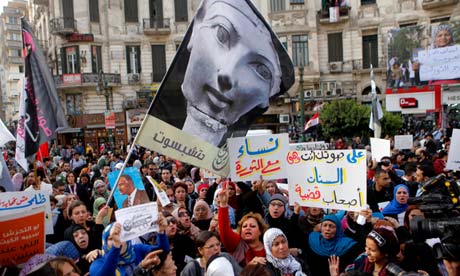
The reaction among brave Egyptian women was one of public outrage, which as we all have come to know, is a dangerous position to take in Egyptian society. Women here in Cairo protesting the Muslim Brotherhood for its statement

As one contemplates the issues of women's rights and quality of life, the realities are quite sobering.

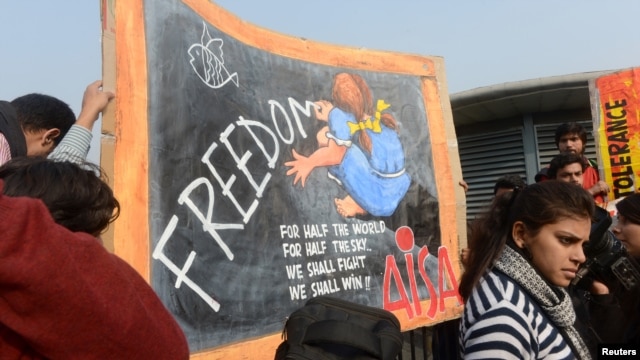
As the recent rape/murder case in India illustrates, the subservient status of women in that country's varied cultures is a deadly one. Just this week, another woman tourist in India believed she had to jump out a third-story window to escape the advances of the hotel owner. On the other hand, Indian lawmakers have taken up the issue with some force - death penalty for rape if it severely injures, a 20-year upper limit instead of seven year sentence for any rape conviction, stalking and voyeurism addressed, and age of consent raised to 18 from 16. See article Indian parliament to debate bill allowing death penalty for rapists

Click on image for full picture
Indian women protest against recent case of violence against their gender.

Sex trafficking and virtual slavery in many countries, but often associated with South Asia and some eastern European nations; the myth of a cure for AIDs by sleeping with a virgin remains alive across Africa; genital mutilation in various cultures - all are the extreme negatives.

A billboard in South Africa tells a sorry story

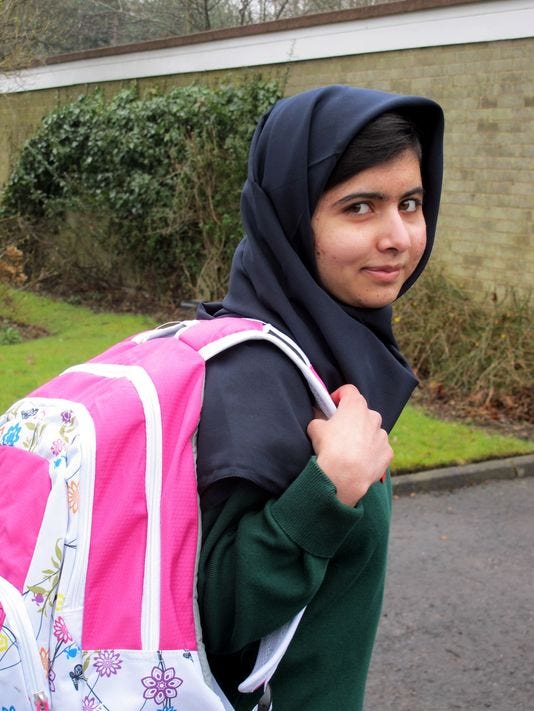
And we've yet to address the positives - improving women's educational opportunities, independent decision making, programs that provide economic opportunities for raising families (the issuing of micro-loans has been a major advance). Schools and education seem to be key, and just this week, Malala Yousufzai, the young Pakistani woman who was shot by the Taliban for advocating for girls schools, has returned to classes (but in the UK ...), see USA today article here

Ms Yousufzai, happy to be a student, considering being able to learn "a gift."

Teatree believes this broad stream of issues truly is a newsworthy global concern.

Sunday, March 10, 2013

Kenya and Venezuela - leadership changes

Well, let's start with Venezuela.

Venezuela, population 30 million, has the third largest economy in Latin America, behind Brazil and Mexico, and recently surpassing Argentina, is also the de facto leader of a group of socialist leaning nations on the continent.

Its president Hugo Chavez died last week after a long struggle with cancer, mainly treated in Cuba. As a Blomberg news article, noted "Chavez was unable to return to Caracas from Havana for a swearing-in ceremony to start his third six-year term on Jan. 10 [2013] after winning about 55 percent of the vote over Henrique Capriles Radonski in October..."

Where does the country go from here - is there a succession plan? Yes, the constitution calls for the Speaker of the National Assembly to fulfill the duties of the office if the president is unable to assume office. And once that occurs, a new national election should take place in 30 days of the change of leadership. The trouble is, Chavez's Vice President Nicolas Maduro has declared himself President after Chavez's death, and the Supreme Court, "packed with Chavez loyalists" agreed. Diosdado Cabello, the current Speaker of the National Assembly, a Chavez supporter but also a rival with Maduro, has backed off, but the process is not being followed.

Shown here with the late Hugo Chavez, the obsequious Muduro is now the top man in Venezuela.

In a bizarre twist, the government leadership has now declared that Chavez's body will be permanently displayed in the nation's capital, and given a new title, "Commandante Eternal." In the UK's Guardian newspaper coverage, "We have decided to prepare the body … so that it remains open for eternity for the people. Just like Ho Chi Minh. Just like Lenin. Just like Mao Zedong," said Nicolás Maduro, the vice-president who was due to be sworn in as president at sunset after the ceremony. ...


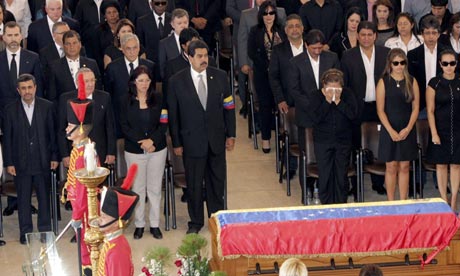
"Dozens of presidents, prime ministers and princes from around the world joined hundreds of thousands of pilgrims at the military academy in Caracas to bid farewell to a leader who simultaneously inspired, enchanted and repelled during his 14-year rule. ... Shown here attending Hugo Chávez's funeral: Mahmoud Ahmadinejad, Prince Felipe, Sebastian Pinera, Rafael Correa and Raul Castro." Guardian Newspaper

The Guardian coverage continues, "Disquiet has grown over the decision. Chávez expressed a desire to be buried in the plains of his youth, far from the capital. On Friday local media unearthed a clip of the president denouncing the practice of preserving and displaying cadavers in 2009. He made the comments in protest when Bodies Revealed, a travelling art and science show of dissected cadavers, visited Caracas. He closed it, citing moral concerns. "We are in the midst of something macabre," he said."

Even "The Bodies" exhibit has been referred to in the ongoing Chavez remains debate ...

And the actual opposition? (For what we've discussed so far is all within the factions of Chavez supporters). The October presidential candidate who lost, Henrique Capriles, upped the ante Friday, stating, ""Do you really need to abuse power to run for election?" he said at a press conference. Taunting the new president in an eerie echo of Chávez's own rhetorical style, Capriles added: "The people didn't vote for you, kid." and referring to the Supreme Court acceptance of Muduro's ascendency, Capriles denounced that ruling and called the inauguration spurious. "What the supreme court did I've qualified as an electoral fraud."

Capriles, stating an obvious, but perilous observation.

This blog post was about Venezuela after Chavez. But in case you are looking for a summary article on the Chavez legacy, try this one: http://www.businessweek.com/articles/2013-03-05/hugo-chavez-rip-he-empowered-the-poor-and-gutted-venezuela Now, onward to another election in Kenya.

Kenya


Kenya, population 41 million, and East Africa's largest economy, held its 2013 presidential election last Monday. On Friday, after days of delays, Uhuru Kenyatta, 51,(son of Jomo Kenyatta, the first President of Kenya as an independent nation) won the office with a razor thin margin of 50.07%. By obtaining over 50% of the vote, he avoids a runoff with the next highest vote gatherer, Raila Odinga, 68, who happens to be the current Prime Minister.

Kenya's newly elected President, Uhuru Kenyatta

The complications of the story is that these two also were the two top candidates in Kenya's 2007 elections, which ended with massive voting fraud (or irregularities) and significant violence along tribal and political lines that ultimately resulted in respected world leaders flying in to help calm the situation. (The position of Prime Minister itself was created in political negotiations after the 2007 election in order for Odinga to assume a leadership role in the nation and thus calm tensions.) Uhuru Kenyatta was subsequently indicted by an International Criminal Court with crimes against humanity, charged with inciting 2007-election violence.

Kenyatta (left) and Odinga (right) both have been vocal in promoting a peaceful election this time.

To the nation's credit this time, citizens have overwhelmingly expressed their desire for peaceful elections, as have the candidates. And so far, so good. While Odinga has said he will challenge the results - which do have plenty of instances of alleged irregularities in voting counting, secure transport, etc - all leaders are still talking of avoiding violence.

Still, to have an indicted individual become president, places Mr. Kenyatta in a rarified and dubious circle. Just two countries have their leaders under indictment for war crimes - the other being the notorious Omar al-Bashir, President of Sudan. Western governments are in a bit of a pickle. The UK policy is to avoid contact with anyone indicted by the ICC, and most push hard and sincerely for open, fair elections with the outcomes being wild cards. (Reference Egypt...). This outcome is an example of another wild card - how do countries do diplomacy with Kenya now?

Factoids: Kenyatta is Kikuyu (Kenya's largest tribe), while Odinga is a Luo (Kenya's second largest tribe), and Kenyatta's running mate, William Ruto, is from the Kalenjin tribe, which has deep political ties stemming from former Kenyan president Daniel Arap Moi, the first Kalenjin to hold that position. It was this alliance of two powerful tribes (one small, one large) that pulled off a first round election victory in early March. US President Barack Obama's father is from the Luo tribe ...

While there were fears of clashes between the major tribal groups, the only violence during the voting process occurred in Mombasa where Islamist seccessionists attempted to push their agenda ...

No conclusions, just that Kenya's election has complications, but congratulations to date for respecting the rule of law, including the bizzare situation of Kenyatta now having to go to trial in The Hague, Netherlands, while governing his East African homeland.

Friday, March 1, 2013

Bangladesh - 32 years later

This week, the country of Bangladesh was back in the news. A top Bangladeshi court ruled earlier in the week that a leader of the country's largest Islamist party was guilty of war crimes during the 1971 war of independence from Pakistan. According to an account in USA Today, March 1, Delwar Hossain Sayedee - one of the top leaders of Jamaat-e-Islami, the country's largest Islamic party - was sentenced to death "for mass killings, rape and atrocities committed during the bloody nine-month war. ... Protesters clashed with police for a second day Friday as the death toll rose to at least 44.

Sayadee, unique because of his striking red beard, becomes the latest political leader that is also been found guilty of war crimes.

The article continues, "Passions have boiled over in recent weeks as tribunals have tried suspects on accusations they committed crimes during the country's war for independence from Pakistan. Bangladesh says as many as 3 million people were killed and 200,000 women raped by Pakistani troops and local collaborators during the fighting. Sayedee, a teacher at an Islamic seminary school when he allegedly committed the crimes, is the third defendant to be convicted of war crimes by the special tribunal set up in 2010. His lawyer Abdur Razzak rejected the verdict as politically motivated. He said his client will appeal to the country's Supreme Court."

Jamaat-e-Islami, a major political party in Bangladesh has called out its members to create violent protests on behalf of Sayedee. (Teatree wonders, whether this is a call for justice to be done, or simply to reject justice that has been done?)

Click on image for full picture
On the other hand, this photo from AlJazeera, shows the rejoicing of many other Bangladeshi's with the verdict, with the opinion that finally, after decades of neglect, some justice is being accomplished.

That's the story - it highlights a number of issues. One is certainly the history of Bangladesh, which was once part of Pakistan, which itself was partitioned in the aftermath of World War II from India.

The name Bangladesh means "Country of Bengal" in the official Bengali language, and it faces the Bay of Bengal to its south. Bangladesh has a population of 147 million, it is an extremely low lying country that endures typhoons, seasonal flooding, and is at risk from any rise of ocean elevation.

Once known as East Pakistan, it broke free from Pakistan in 1971 ... As Wikipedia puts it, " Due to political exclusion, ethnic and linguistic discrimination and economic neglect by the politically dominant western wing, popular agitation grew and gave rise to a secular cultural nationalist movement, leading to the declaration of independence and Bangladesh Liberation War in 1971. In the aftermath of war and independence, the new state endured poverty, famine, political turmoil and military coups. The restoration of democracy in 1991 has been followed by relative calm and economic progress."

In this apparently old map, Ceylon, at the tip of India, is now called Sri Lanka, and Burma is now called Myanmar

Another issue is the court itself. Called the International Crimes Tribunal, one Bangladeshi newspaper describes it as "a domestic body with no international oversight, was created by the government in 2010 and has been tainted by allegations it is politically motivated." So the question becomes, indeed, is this justice served or retribution - one would think that setting up such a body headed into the murky world of war crimes would want a larger international network of legal support behind it. The absence of which allows, as we are seeing, protests regarding its legitimacy. A total of 11 top opposition figures — nine from the Jamaat party and two from the main opposition Bangladesh Nationalist Party (BNP) — stand accused of war crimes.

As the article notes, "Both Jamaat and the BNP have called the cases “politically motivated and farcical”. International rights groups have questioned the proceedings and found loopholes in the war crime laws."

The third issue, is of course, the nature of the crimes themselves. As a UK Guardian newspaper article notes, "Much of the mistrust is rooted in Bangladesh's tumultuous past. Bangladesh declared independence from Pakistan in 1971. The Pakistani army fought and lost a brutal nine-month war with Bengali fighters and Indian forces that had intervened. Hundreds of thousands of civilians died, many of them at the hands of Islamist militia groups who wanted the country to remain part of Pakistan. .. Full article at http://www.guardian.co.uk/world/2013/feb/23/protest-death-penalty-bangladesh.)

Bangladesh has its own images of the cost of freedom, and the price war brings.

More specifically, according to an article at Forbes Magazine, "Many academics state that the first time rape was consciously applied as a weapon of war was during the Bangladesh War of Independence." Between 200,000 and 400,000 rapes occurred, as can be read about in the article - http://www.forbes.com/sites/worldviews/2012/05/21/1971-rapes-bangladesh-cannot-hide-history/

This photo shows a commemoration connected with the violence committed towards women during the 1971 war with Pakistan. A blog posting on the subject can be found at http://anushayspoint.com/2012/07/17/i-am-the-war-heroine-speaking-a-special-series-on-women-bangladeshs-war-of-independence/

So, one can hope that Bangladesh is truly coming to grips with its past - a good place to start from, even if decades later.

Wednesday, February 20, 2013

Tunisia - the end of the Arab Spring? Was there one?

Okay, most folks will now acknowledge that the hoped for "Arab Spring" has not turned out to be anything like the collapse of the Soviet Union in 1989-1991, where nations emerged from the yoke of dictators and embraced parliamentary democracy. And while there were plenty of examples in Eastern Europe where the changeover did not go well (Belarus, Russia, and the breakup of Yugoslavia in another round of Balkan fighting) or unevenly (Ukraine, Czechoslovakia), most countries have truly moved on in a positive manner.

It is hard to find any such parallel in the Arab world. Egypt is in turmoil, Yemen violent, and Libya remains fragile. Jordan, Bahrain, Kuwait, and Morocco all experienced noticeable unrest, but little substantive changes were made to governance (though in several cases, the governance is relatively benign). Iranian protests were not supported in any way by the West and the belligerent rhetoric from the Islamist leaders there continues to fly. Syria's blip of democratic protest morphed, tragically, into a grotesque civil war of attrition, and Lebanon remains frozen under the Hezbollah shadow.

Click on image for full picture
Arab nations that had a whiff of protests ranging to outright regime change ...

Now Tunisia, where the protests began, has fallen back into crisis - a very unfortunate turn of events, as this nation of 10 million had been widely seen as one in which true democracy may have had a chance. As an AP news article puts it, "Prime Minister Hamadi Jebali on Tuesday carried out his promise to resign, after his offer to solve the country's political bickering with an apolitical government of technocrats was rejected by his own Islamist Ennahda Party."

The article continues, "On Feb. 6, Chokri Belaid, a leftist Tunisian opposition politician and sharp critic of the government, was assassinated by four shots through his car window early in the morning outside his home. Those killers have yet to be caught, but people immediately suspected the government and days of unrest and rioting convulsed the country afterwards.

Click on image for full picture
A Tunisian politician, Chokri Belaid, leading the opposition to the Tunisian government was assassinated in early February. From one newspaper account, "Belaid had been critical of Tunisia’s leadership, especially Ennahda, and had accused authorities of not doing enough to stop violence by ultraconservatives who have targeted theaters and art exhibits seen as out of keeping with their strict interpretation of Islam."

Belaid's death did not kick off the crisis, however. It was only the culmination of a long-brewing stalemate between the ruling coalition and the opposition against a backdrop of dashed popular expectations, rising prices, crushing unemployment and an economy that is not getting back on its feet.

After a year of governing by the "troika," an alliance of Ennahda and two secular parties, there was a wide consensus that many ministers were incompetent and the urgent problems that had sparked the revolution were not being solved."

Again, the article goes on,

"THE STAKES
Tunisia is certainly not the biggest, richest or most influential Arab nation. It does, however, have one of the best educated populations and lacks the wide gaps between rich and poor found in places like Morocco and Egypt.

While a dictator, Tunisia's first post-independence leader Habib Bourguiba invested heavily in education, producing a literate population that is predominantly middle class and is widely considered to have one of the most promising profiles for becoming a prosperous democracy."

Tunisian youngsters benefiting from a solid national educational system - is it too at risk?"

So, not much more to add at this point. Where Tunisia heads now is somewhat foggy. A Reuters article describes the near term future this way, "Tunisian leaders began the search for a new prime minister on Wednesday to try to lead the North African nation out of its gravest political crisis since an uprising that inspired a wave of Arab revolts two years ago.

Rached Ghannouchi, the powerful head of the main Islamist Ennahda party, said the group had not named anyone to replace Prime Minister Hamadi Jebali, who resigned on Tuesday, but that he expected a new government to emerge this week.

"We need a coalition government with several political parties and technocrats," Ghannouchi told reporters after talks with secular President Moncef Marzouki."

Click on image for full picture
Some of Tunisia's basic economic industry sectors. Green areas are olive growing regions, purple is for vineyards.

Last year in March, the ruling coalition (now in disarray) had scheduled new elections by this coming March 20, 2013. One assumes those are on hold for several months at the earliest in order to solve the immediate crisis.

Let's hope that those in Tunisia's political class can rise above their preferences for the good of the nation. And let's always remember there are happy situations in any country.

For example, tourists can enjoy camel rides along the Mediterranean sea ...

Mediterranean climate encourages a great variety of foods - shown here in a market

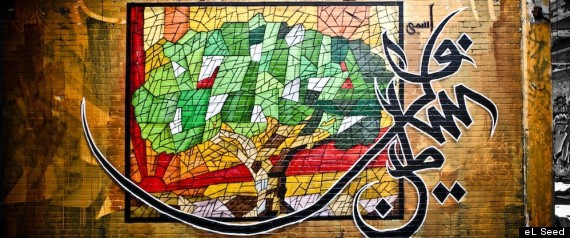
Graffiti from a 31 year old Tunisian artist, eL Seed http://www.huffingtonpost.com/2012/09/27/el-seed-tunisian-graffiti-artist_n_1918493.html

Wednesday, February 13, 2013

Leader of the Catholic Church plans to step down

Pope Benedict XVI rocked members and followers of the Catholic church by announcing his plans to step down from his role as church leader. The Catholic Church worldwide claims the allegiance of approximately 1.2 billion people (that's 1 out of every six individuals on the planet). Pope Benedict XVI, an 84-year old German, stated he was getting old and unable to meet the demands of his office. Seems to be a reasonable position and some would say, a courageous decision, as it sets an example for many other world leaders who have transformed their position into one to last a lifetime, and likely further into a dynasty for their own upcoming family members. On the other hand, this is the first time in over 600 years that a Pope resigned rather than dying in office, so it is clearly not a common action.

Pope Benedict XVI, formerly Cardinal Ratzinger from Germany, is approaching 85, the first German Pope in 1000 years, and has been a theologically conservative leader.

The Catholic's view of the leader of the leader of the Church.

Church teachings state that the Pope in office represents the unbroken line of successors to the Apostle Peter, to whom Jesus said in Matthew 16:

He [Jesus] said to them, ‘But who do you say that I am?’ Simon Peter replied, ‘You are the Christ, the Son of the living God.’ And Jesus answered him, ‘Blessed are you Simon Bar-Jona! For flesh and blood has not revealed this to you, but my Father who is in heaven. And I tell you, you are Peter and upon this rock I will build my church, and the powers of death shall not prevail against it. I will give you the keys of the kingdom of heaven, and whatever you bind on earth shall be bound in heaven, and whatever you loose on earth shall be loosed in heaven.’”

From the Catholic church website, we can read, "The Catechism of the Catholic Church states that the Roman Pontiff, head of the college of bishops, enjoys infallibility in virtue of his office, when as supreme pastor and teacher of all the faithful – who confirms his brethren in the faith – he proclaims by a definitive act a doctrine pertaining to faith and morals."

Interesting view of the number of Catholics around the world. Hardly any numbers in Asia, though the Philippines is strong. Then Mexico and Latin America outpace the US.

And from there, the debates erupt. Protestants and unbelievers speaking from a thousand different perspectives, resent, reject, and bristle at the thought of infallibility in a human, that God speaks through this person who has by virtue of his role (no women here) can bind decisions not only on earth but in heaven.

Of the many accusations against the Catholic church through the ages - the inquisition, how Catholicism spread during the colonization period, the concerns of Vatican city connections to Nazi's in WWII - the latest has been most damaging: instances of child sexual abuse by priests and less than aggressive efforts by Bishops and Cardinals to root out the offenders.

The Catholic church itself from a global perspective is as diverse a body as can be imagined. Relatively rich Western countries have Cardinals and Bishops overseeing debates and scandals from sex abuse from its priests, declining membership, and resistance to teachings that are out of touch with secular norms (abortion/pro choice, use of birth control, limited roles for women in authoritative positions). Yet membership is growing in African and Latin American countries where poverty and social justice issues have been the background where Catholic leaders have stood on the side of righting wrongs.

Numerous catholic institutions serve the poor, provide education, health, shelter and comfort. Mother Teresa is a well known example, but lay groups, orders of sisters, Catholic Relief Services all feed into a true force of Christian service.

In any case, this Pope's resignation - set for the end of February - means that a new successor to the original Peter is getting underway. A "conclave" will be organized where all Cardinals under the age of 80 are eligible to vote for the next Pope. Apparently there are 118 of these, though 67 were given their appointments by Pope Benedict himself.

Here are the Cardinals who will select the next Pope

Conclaves that decide on each Pope, let's say the past three or four pope's have brought about discussion and debate about whether the new Pope should be Italian, Western European, or from Africa, or Latin America, whether the new one should be relatively young and therefore likely to remain in office for some time, or older, bringing about change once again on a faster schedule. The word "papible" has popped up - one having the necessary qualities of a Pope.

The previous pope, John Paul II (Karol Józef Wojtyła) was the first Polish pope and first non-Italian pope in 455 years. He was in office from 1978 to 2005.

Pope John Paul II, was a key individual in supporting fellow Pole Lech Welesa in challenging Communism in Poland, and with Moscow's Gorbachev during his policies of glasnost and perestroika

Before him was John Paul I (Albino Luciani), an Italian who was in office one month before passing.

Before him was Paul VI (Giovanni Battista Enrico Antonio Marìa Montini) an Italian in office from 1963 to 1978, and was the first Pope to ever visit the United States in his official capacity. (That of course, reminds Teatree that John F Kennedy was the first Catholic US President (1960-1963), and a debate over whether he would answer to the Pope or follow the Constitution was an important decision point for Americans)

A CBC news photo - President John F. Kennedy talks with Pope Paul VI at the Vatican on July 3, 1963. The meeting was historic: the first Roman Catholic president of the United States was seeing the Roman Catholic pontiff only days after his papal coronation. President Kennedy was assassinated later that year.

So onward. Many young Westerners do not see the Catholic church as relevant as the earlier generations - indeed a group of 100 men most over the age of 55 picking from among themselves does give off a sense of yesterday - but the institution has shown its resiliency and influence many times in the past.

Smoke coming from a chimney at each Catholic conclave signals the inconclusive or conclusive votes cast for a new Pope. This also seems antiquated ... doesn't it? (PS - black smoke means a failed ballot, white smoke means a selection has been successfully made.)

Dare we say, "good luck"??

Friday, February 1, 2013

US Secretary of State: What difference does it make ...?

Yesterday was US Secretary of State, Hillary Clinton's last day on the job - John Kerry, former Senator of Massachusetts, will be sworn in Friday afternoon for this important post. As Mrs Clinton leaves her position, her rhetorical question in hearings several days ago regarding the September 11, 2012 Benghazi attack will, unfortunately, linger for some time.

A region where intelligence matters

Mrs Clinton was defending her agency and the administration's handling of the incident nearly 5 months ago when US Ambassador to Libya, Chris Stevens, was killed by terrorists. When pressed to explain why the Obama administration clung to a theme of a video inciting passions from a mob for nearly two weeks after the killing, she shot back, "“Was it because of a protest or is it because of guys out for a walk one night and they decide they go kill some Americans?” she asked rhetorically, before adding: “What difference, at this point, does it make?”

The difference is key - and strangely, neither reason mentioned by Clinton was yet the right one. "It" was neither a protest, nor a spur of the moment decision. The correct answer, for some reason still not able to be acknowledged by the Secretary of State, was a deliberate attack by al-Qaeda linked groups. Her answer, in retrospect, was also testimony to a variety of questionable foreign policy lines being followed by the US.

One of the more damning issues of the case revolved around repeated requests by the American diplomatic corps in Libya over the summer for more protection from growing extremist threats - assistance that never arrived. In the months that have followed the attack, there has still been no progress in determining the militant groups, and continued fog over when assistance was asked for, and how far up in the Obama administration did the requests go.

The US consulate in Benghazi, Libya, where four Americans, including the US Ambassador to that country, were killed

Connected to the lack of response to providing increased security, another question is whether the Obama administration has allowed its own narrative of describing the last two years of unrest in Arab nations as a positive "Arab Spring" to cloud a clearer, and more sober assessment. Also linked, the Obama administration trumpeted its Libyan response - one of leading from behind and gaining the support of the Arab League and the UN before it acted to topple Gadaffi - as the smart approach versus the previous administration's efforts in Iraq and Afghanistan.

Does intelligence matter?

First, even Teatree recognizes that Mrs. Clinton's answer was 100% political, in response to 70% politically motivated questions by preening US Senators. It is Teatree's opinion at the same time, that the current administration is only 50% as interested in pursuing the matter as it should be.

With that said and returning to the question, in the middle of the Iraq war, many journalists noted that the intelligence gathering efforts by young US captains among the Iraqi population was the key to a slowing of the civil war. Deliberately putting US forces out in the neighborhoods during the 2006 surge also spurred further "understanding" between arguments, revenge killings, ethnic fighting, and al-qaeda attacks - all critical to the country's return to less violent levels.

The "horrors" of rendition, enhanced interrogation, and Guantanamo's detention center all revolve around collecting intelligence in order to act more precisely. Teatree notes that the unease over these actions ebb and flow with a high degree of correlation to the political winds ...

The Obama administration's reliance on drone attacks are increasingly being challenged, though only quietly in articles or speeches that do not become mainstream media fodder. The UN is even out front on this one by beginning an inquiry into the use of lethal drone strikes where collateral damage to those around the target person are seemingly discounted. More practically, military experts note that each drone strike obliterates future intelligence gathering from that individual in question, or those around that person.

The increasing reliance on armed predator drone strikes by the current US administration as its preferred approach to handling the "war on terror" is only heightened by the near unanimous and silent acquiescence by the Western media.

The question lingers

The ill-put question by Mrs Clinton has no partisan boundaries. Intelligence or the lack thereof concerning weapons of mass destruction in Iraq in 2003 will forever taint that conflict, even if Iraq is able to successfully emerge with hope from its dark and brutal days under Saddam Hussein.

Mrs Clinton testifying and defending her actions, along with the Obama administration, in Benghazi Libya prior to September 11, 2012, and the nearly five months since.

In contrast to the vague responses by the US, the UK, Netherlands and others called for their citizens to leave Benghazi due to possible further terrorist attacks just since Clinton's Senate grilling. And the increasingly apparent lack of followup in Libya as to securing weapons caches has resulted in security turmoil in the Sahel.

Yes, Mrs Clinton, who did what, when, why and how makes all the difference ...

As one opinion piece from America's Southern Wisconsin heartland summarizes: "It was like asking: “What’s the difference between hitting a deer that bolts out in front of your car or running over some kids on a field trip because you’re blind drunk.” One is an accident; the other is a catastrophic failure of judgment.

The administration now acknowledges the assault in Benghazi was a deliberate, planned terrorist act. It is reasonable—indeed, necessary—to ask if State did everything reasonable to mitigate the risk.

We know there was no shortage of funds or other resources. Senior State Department officials have repeatedly testified there was no problem there—though some politicians continue to cry poverty on behalf of the administration. Clearly, the problem was the department’s failure to plan adequately before the attack and respond adequately once it began.

Seeing no difference between a riot and a raid also suggests Clinton doesn’t understand the nature of the threat. “Islamist terrorists,” wrote my colleague Middle East scholar Jim Phillips, “are motivated to kill Americans not because of emotional reactions to alleged slights such as the questionable video on Mohammed, but because they seek to seize power and impose their Islamist totalitarian ideology on other Muslims.”

Clinton just doesn’t get that. Her testimony revealed a leader unapologetic for her failure to act or understand. Worse, she showed no real interest in learning from the incident. Such knowledge could help her department better adapt to the emerging threats in the region."


Fast rising issues where what we know makes a difference

The validity of intelligence gathering will be critical in containing the fallout of yesterday's Israeli strike in Syria over weapons being moved to Lebanon.

The left-wing terrorist suicide bombing at the gates of the US embassy in Turkey today (Friday, February 1, 2013)has been more quickly characterized than has been the Benghazi attack in September.