North Korea

North Korea
The always bombastic and unpredictable North Koreans go hysterical again. This time the country is prepared to "go to war" with South Korea because that country is playing loudspeakers directed at North Korean territory. A headline from a UK paper reads, "More than 50 North Korea submarines 'leave their bases' as war talks with South continue "
Showing posts with label refugees. Show all posts

Tuesday, June 16, 2015

Malaysia as destination for climbers and refugees

Malaysia has crept into the news the past few weeks - first as a destination for desperate refugees from Bangladesh and Myanmar - and second as the scene of an earthquake on its highest mountain, Mt Kinabalu.


Malaysia, with a population of 30 million has two parts, East and West, separated by 400 miles of open sea. (Talk about borders being arbitrary from legacy governance ..., but to its credit, Malaysia has made it work.) Graphic from wwp.greenwichmeantime.com

Refugees from Bangladesh and Myanmar have worked hard to enter this country by any means. By and large, the arrival of Muslim Rohingya of Myanmar have been quietly tolerated in this Muslim country over the years. But with the number of boat people doubling in the first three months of 2015 compared to 2014 (25,000 as a broad estimate), Malaysia has said enough.

Still, how has Malaysia become a beacon? From nationsencyclopedia we read, "Since 1970, the Malaysian government has actively implemented social policies aimed at the elimination of poverty and social inequality, and the development of a social welfare system . The communal unrest of 1969 prompted the Malaysian government to introduce the New Economic Policy (NEP). This 20-year program established state support of poor communities and access to education and social benefits for Malays and indigenous people (the Bumiputera ). This latter aspect included the establishment of privileged access to public services, the granting of land rights, preference in education and training, and job quotas in the public sector. In the 1980s, Malaysia's leadership envisioned the formation of the Malay Baru (New Malays), a better-educated, politically and socially active people able to live in harmony with other communities. In the early 1990s the government relaxed some privileges and reduced some quotas for Bumiputera, making the social welfare system more inclusive and accessible to a wider range of people than it had been before."

Malaysia has been characterized as a moderate Muslim nation, yet, like Turkey, has recently shown some inclination to the siren call of Islamic fundamentalism.

Along with its commendable initiatives to address poverty and inequality, Malaysia has long exhibited a moderate version of Islam. Its constitution is secular, though Sharia law acknowledged as adjunct. Unfortunately, its current Prime Minister has recently tolerated or ignored growing comments among his administration that promote a harsher, "purer" adherence to Islamic principles.


Malaysian Prime Minister Najib Razak has been criticised for openly praising Islamic State militants. AFP: Nicholas Kamm

Malaysian academic and writer Farouk Peru is one of two dozen leading Malaysian voices that, back in December 14, wrote an open letter to the government, expressing their concern about the direction of the country's religious inclinations. In an interview, he stated, "I myself wrote an article in the Malaysian Insider saying that Najib does not exactly know what he's saying," he said. "I really believe this because I do not believe that Najib is of a fundamentalist bent, but what I do believe is that there is an infiltration of Islamo-fascist elements within the prime minister's department and you can see that coming from his department, all sorts of things which are ridiculous.

"Yesterday we had someone say that liberalism and pluralism are deviations against Islam ... I mean this kind of stuff never came out before but I think Najib is too complacent and he doesn't realise really what the implications are."


Farouk Peru, a Malaysian intellectual, and self described "human being in the world, blogging my existence." He is currently a Phd Candidate in Islam and Postmodernism and teaches Islamic Studies at King's College, London. An essay or two to get a flavor of this Muslim thinking and writing about his faith. The second essay is a reflection on the Charlie Hebdo massacre that occurred in France in January, 2015. Photo at www.wn.com

Before the refugee crisis, the disappearance of a Malaysian jetliner brought the country into the spotlight of western media, and now, the latest is the detainment and deportation of young Western yahoos who decided to climb a revered mountain in East Malaysia, take off their clothes and take selfies of themselves on May 30.

That alone probably would have not become a story with any reach, but unfortunately, "by coincidence" there was an earthquake five days later which killed 18 people including children, and leaving hundreds more stranded. With rumors subsequently connecting the two events, East Malaysian authorities stepped in and detained the Western tourists. No flogging however, just the roundup, detainment, a fine, followed by sending them packing back to their homelands.

From CNN, "Four foreign hikers who posed naked on Mount Kinabalu in Malaysia were freed Friday after they were fined and sentenced to time served. The backpackers -- from Britain, Canada and the Netherlands -- were arrested after stripping naked May 30 and posing for photos on the mountaintop, the nation's Bernama news agency reported. The mountain is considered sacred in Malaysia. They had pleaded guilty to "committing an obscene act."

At 13,435' (4,095 m), Mount Kinabalu has snow, is considered sacred, where ancestors spirits dwell, and up which tens of thousands climb each year due to its relative accessibility. Photo from
www.mountkinabalu.com


So, a glimpse at Malaysia.

Sunday, June 29, 2014

Refugees and other flows from regional conflicts grow

"The first casualty, when war comes, is truth" is a statement that has been often repeated and modified. It is attributed to Hiram Johnson (1866-1945), a "staunchly isolationist" Republican senator from California in reference to World War 1. (Hmmm, the 100th anniversary of what is considered the precipitant act of that war was held this week. As the Australian Broadcasting Service (ABC) concisely summarizes, "the Archduke Ferdinand - the heir to the Austro-Hungarian throne - was shot dead with his wife Sophie on a June morning in 1914. Ferdinand's murder by Gavriol Princip, a 19-year-old Bosnian Serb, set the Great Powers marching to war. More than 10 million soldiers died, as empires crumbled and the world order was rewritten.")

Click on image for full picture
Yes, the 100th year commemoration of the assassination, carried out by the Bosnian, Gariol Princip, was held in Sarajevo, Bosnia and Herzegovina, but not without controversy!. Apparently the killing is seen very differently by Bosnians, Croats, and Serbs. To some in Bosniak parts of the country, Princip was a terrorist; to some Serbs, he is largely viewed as an ethnic Serb nationalist, while others see in him a pan-Slav idealist. In this picture by the BBC, a Serbian flag is carried in the eastern B-H town of Visegrad at a separate commemoration more sympathetic of Princip.

So where was I? Teatree's POINT is that one could come up with other firsts besides truth being the first casualty. While there is little doubt that truth is quick to go - yes, yes, and yes - Teatree observes that the wrenching of civilians from their homes may even come sooner.

Three refugee flows

Inside Iraq

We've read much of Syria's streams of civilians heading to Turkey and Jordan - hundreds of thousands - and some were even a couple years ago fleeing to Iraq. But with ISIS in Syria and Iraq making the news this past two weeks, tens of thousands of Iraqis themselves are fleeing in all directions - mainly to safe parts of their now divided country.

Click on image for full picture
Iraqis from Mosul fled everywhere, but many into the autonomous Kurdish controlled region. Photo from redstate.com

Between Russia and the Ukraine

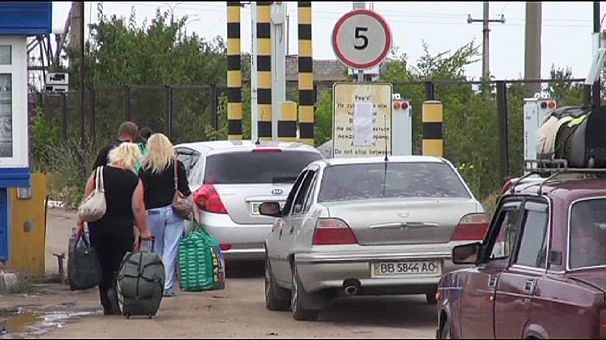
There are thousands on the roads in Eastern Ukraine. Some are heading to Russia or pro-Russian strongholds in the east of the country, while some Eastern Ukrainians are headed west to safer Ukrainian territory. The UN puts a number on internal movements - 54,000 - but notes that another 110,000 Ukrainians have gone to Russia since the first of the year.

Click on image for full picture
Pro-Russian civilians (or those simply concerned for their families' safety) going through border crossing into Russia. Photo from www.euronews.com

From Central America to the U.S.

There isn't exactly a war or conflict going on in several Central American countries - Honduras, El Salvador, Guatemala, - but it is clearly a desperate situation that stems from poverty, the rise of gangs, and violence of drug cartels in these small nations. What is unique is that children are being sent on their own to the U.S., no doubt assuming the U.S. is much less likely to return children than it would adults traveling alone.

Click on image for full picture
Central American families (not strictly just children) arriving in great numbers. An ABC article states, "The Department of Homeland Security says more than 52,000 unaccompanied minors have been detained along the U.S. border with Mexico this fiscal year. In addition, authorities have apprehended 39,000 adults with small children. The numbers reflect a significant uptick over last year, when just 24,000 unaccompanied minors were apprehended. The majority in the surge hail from Central American countries, and a disproportionate number are young women and under age 13, officials say." Photo from rt.com

Click on image for full picture
Countries under great stress, and parents sending children north Graphic from Mother Jones.com

One other flow

We've seen it before: in Libya after the overthrow of Gaddafi, unsecured weaponry flooded North African countries, and many say these weapons fueled the uptick of strength in Boko Haram and was responsible for the surge of conflict in Mali.

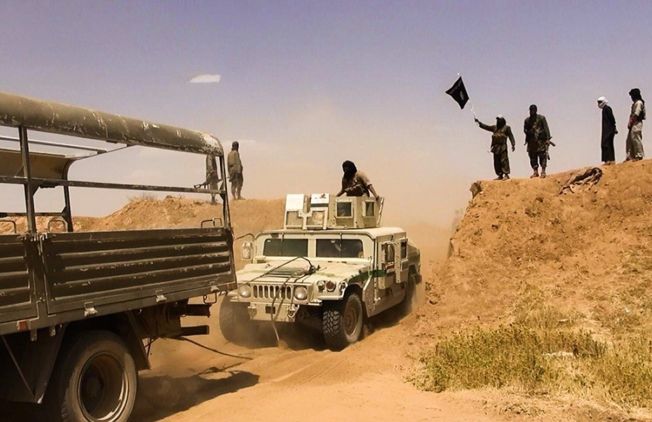
Today, a new flood of weapons is on the move. In Iraq, vast amounts of weaponry, along with vehicles and armor, changed hands. It came from Iraqi army units that melted in front of ISIS fighters, and immediately seized by ISIS itself.

Click on image for full picture
This graphic shows, if nothing else, that the border between Iraq and Syria is for now, a moot boundary. A sand berm that once delineated the line was bulldozed out by ISIS forces. ISIS or ISIL? These are Western terms, the militants refer to themselves as simply jihadis for "al-Dawla", Arabic for the State. That's the main point, they don't view the Syrian or Iraq boundaries as significant, as they are trying to establish their own Caliphate. Graphic from the BBC

Click on image for full picture
Not "just" small arms, but vehicles, tanks, missiles - and in many cases American made - have passed into ISIS hands. These incidentally are coming through early breaks in the sand berm that once delineated Syria from Iraq. Photo from www.vg.no

And so they go ...


Sunday, February 9, 2014

Switzerland wrestles with immigration

Switzerland is a mountainous country set in the middle of Western Europe, maintaining a studied, though cordial, distinctiveness from its neighbors for the past several hundred years. Today, for example, Switzerland is not a European Union country, and in World War II and I, maintained an armed neutrality that irritated allied forces, yet provided some space for safe havens, and lines of communications between the belligerents.

Switzerland, with a population of around 8 million, is prosperous, respected, and intriguing to Teatree as each citizen, statistically, reportedly consumes more than 19 lbs of chocolate per year. Factoid and photo from www.countryreports.org

Click on image for full picture
Switzerland is also one of the most visited countries of the world due to its storied mountainous terrain. Photo from http://german.fansshare.com

According to a Reuters article, "Swiss voters on Sunday narrowly backed proposals to reintroduce immigration quotas with the European Union, Swiss television reported - a result that calls into question bilateral accords with the EU and could irk multinational companies. While neutral Switzerland is not a member of the EU, its immigration policy is based on free movement of citizens to and from the EU, with some exceptions, as well as allowing in a restricted number of non-EU citizens.

That pact on free movement of people, which came into force 12 years ago, was signed as part of a package of agreements with the EU, some of which could now be in danger of unraveling, to say nothing of the effect on a globally oriented economy that employs large numbers of foreign professionals."

Click on image for full picture
A poster against the ‘mass immigration initiative’, in Lausanne Switzerland, depicting the fear than unlimited immigration would undermine Swiss "alpine culture." Photo from www.themalaymailonline.com

The article continues, "In a nail-biting vote, 50.3 percent backed the "Stop mass immigration" initiative, which also won the required majority approval in more than half of Swiss cantons or regions, Swiss television said. The outcome obliges the government to turn the initiative, spearheaded by the right-wing Swiss People's Party (SVP), into law within three years.

It reflects growing concern among the Swiss population that immigrants are eroding the nation's distinctive Alpine culture and contributing to rising rents, crowded transport and more crime. Net immigration runs at around 70,000 people per year on average. Foreigners make up 23 percent of the population of 8 million, second in Europe only to Luxembourg."

So, the margin of the win was razor-thin, reflecting perhaps more of the torn-nature of the Swiss over the issue than a clear direction. According the Reuters article, "The provisions of the initiative require the restriction of residence permits for foreign nationals, including cross-border commuters and asylum seekers, according to quotas, the government said in a statement. These limits will now need to be defined at a legislative level ..." But the specifics are left for discussion, and three years into the future for implementation.

Immigration and borders are stressed around the world

The multiple issues of national identity, culture, assimilation, and border control are not limited to the Swiss. The US has long been embroiled in the concerns over Mexican and Central American immigration along its southern border.

The irony behind America's current debate over illegal immigration. Graphic from un-named facebook source ...

Illegal immigration is usually one where a country resists inflows into its national space, the most graphic exception was during the Soviet Union, where citizens within the workers paradise were closely watched to prevent their leaving.

In this famous picture, East German soldier, Conrad Schuman, leaps to freedom in West Berlin in August 1961. Photo from http://photographoftheday.blogspot.com

Click on image for full picture
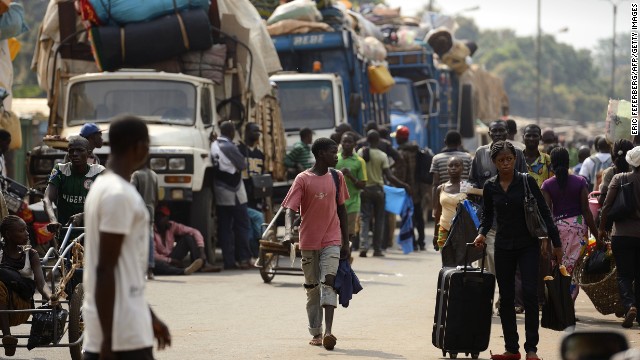
Far from elections and effective governance, the latest surge of immigration is into Chad from the horrific violence in neighboring Central African Republic. Here, Muslim citizens chaotically gather into convoys to leave their CAR homeland under Chadian armed escort. They are suffering retribution for the brief but savage misrule by a now-deposed Islamic leader who brutalized Christians in the CAR during much of 2013. Photo from cnn.com

The examples of border tensions are everywhere - Australia and Southeast Asia neighbors; North Africa to Southern Europe, Eastern Europe to Western Europe, etc. Borders and visions of greater freedoms or flight from persecution do not mix well.

Click on image for full picture
Another surge of immigration (or in this case, emigration from the Syrian civil war) creates the danger of permanent refugee camps. Here, Syrian refugees in a Turkey camp, protected by, one assumes, Turkish soldiers. Photo from http://en.wikipedia.org

Assuming there is a reasonable responsive governance to begin with, Teatree tends to side with stronger border controls linked with generous legal immigration quotas. The absence of which places illegal immigrants at risk in any country where though they contribute to the specific nation's economy, yet they are "second class" - without access to the full complement of citizens rights: voting,citizenship papers, social security benefits, etc.