North Korea

North Korea
The always bombastic and unpredictable North Koreans go hysterical again. This time the country is prepared to "go to war" with South Korea because that country is playing loudspeakers directed at North Korean territory. A headline from a UK paper reads, "More than 50 North Korea submarines 'leave their bases' as war talks with South continue "
Showing posts with label iraq. Show all posts

Saturday, May 30, 2015

Turkey's rulers seek a "pious generation" amidst a threatening region

Turkey continues to present a mosaic of contradictory policies and positions to the world as its June 7 parliamentary elections near. The elections will decide the makeup of the 550 members of the Grand National Assembly, and the elected members will form the 25th Parliament of Turkey.


Turkey has a population of nearly 75 million people, compared to Egypt's 82 million and Germany's 80 million. The country sits strategically between Europe and the Arab world, and it has a turbulent history with its neighbors. Graphic from thesmokingnun.wordpress.com

From wikipedia, we read, "The governing Justice and Development Party (AKP) will seek a fourth consecutive term in government. Its leader, Ahmet Davutoğlu, will seek a full term as Prime Minister of Turkey in his own right, having taken over from Recep Tayyip Erdoğan in August 2014. The AKP's goal is likely to be to win more than 330 seats in order to have the right to put constitutional changes to a referendum, or more ideally 367 seats to bypass a referendum and change the constitution directly within parliament."

Turkey's President Recep Tayyip Erdoğan, campaigning for his AKP party which is expected to gain a majority of seats in the June 7th election. Such a majority in turn would allow him to adjust the country's constitution to reflect his own vision of the nation and Turkey's leadership in the region. Photo from The Economist with the article here.

So what direction is Erdogan, with his party, wanting to take Turkey?

As a recent BBC article (found here) put it, "Under the 12-year rule of the Islamist-rooted AK Party, constitutionally-secular Turkey has fundamentally changed. There is now a push to raise a "pious generation"

The article continues, "The government has constantly stressed its vision of stay-at-home mothers, urging three children per family. Last year, the deputy prime minister told women not to laugh in public; the president recently insisted that men and women were "not made equal".

And from the Economist article noted above, "seen against the background of his recent behaviour, Mr Erdogan’s plans for a strong presidency are troubling. He has dismantled checks on his power. His approach is majoritarian and divisive: so long as his party wins elections, it can trample any critics. Critical newspaper groups have been subjected to capricious tax fines. Columnists have been fired. Turkey had more journalists in jail than any other country until the middle of last year, when a clutch of 40 were let out. Reporters Without Borders, a Paris-based group, ranks it 149th of 180 countries for press freedom, above Russia but below Venezuela.

The authorities have often tried to close off access to critical websites and social media. In the second half of 2014, Turkey filed 477 requests to Twitter to remove content, five times more than any other country. And since Mr Erdogan became president, 105 people have been indicted for insulting the head of state.

Attacks on the media and a harsh crackdown on the protests in Gezi Park in Istanbul two years ago deepened a rift with the supporters of Fethullah Gulen, a Muslim preacher. The Gulenists, formerly Mr Erdogan’s allies against the army and the secular establishment, have now become enemies. The battle with them intensified after tape recordings of AK officials taking bribes were leaked. Mr Erdogan promptly reassigned hundreds of policemen, prosecutors and judges who were looking into cases of alleged graft."
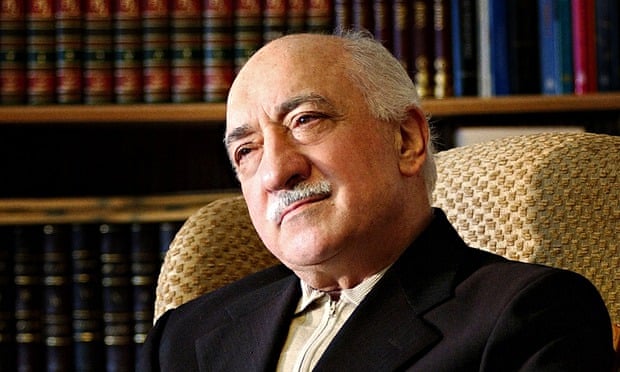

President Erdogan has raised the debate with Fethullah Gulen, a former imam, who is self-exiled in the U.S. Gulen, who has millions of Turkey supporters, "teaches an Anatolian version of Islam, deriving from Sunni Muslim scholar Said Nursî's teachings. Gülen has stated that he believes in science, interfaith dialogue among the People of the Book, and multi-party democracy. He has initiated such dialogue with the Vatican and some Jewish organizations" according to Wikipedia. Photo from The Guardian

Gülen is actively involved in the societal debate concerning the future of the Turkish state, and Islam in the modern world. He has been described in the English-language media as an imam "who promotes a tolerant Islam which emphasises altruism, hard work and education"

Turkey's contradictions and tensions abound.

Even as Erdogan states clearly where his citizens should head, there is increasing discord by a variety of minorities within Turkey itself. Izmir, Turkey's third largest city and on its westernmost coast, is home to the opposition CHP party, which is the party of modern Turkey's founding father, Kemal Ataturk. The party is adamantly secular, strongly pro-women's rights, and nervous about the AKP's push to Islamicize the population. It made recent news by holding women bicycle rallies to offer a different vision for women rather than accepting a subservient Islamic role.
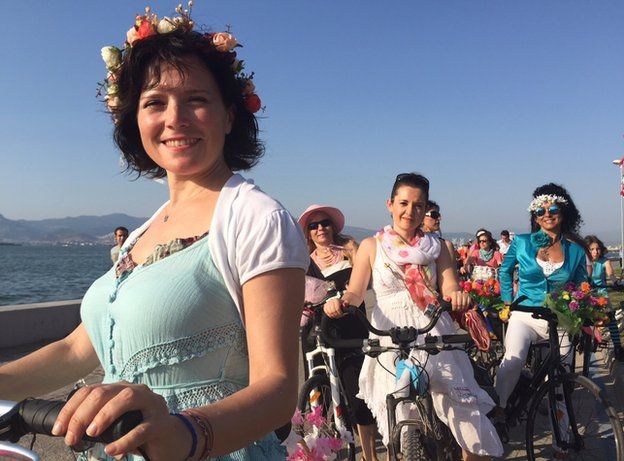

Izmir women on bicyles - a threat to Erdogan's pious generation? Photo from the BBC


Not to be outdone, President Erdogan also rode a bicycle with a few of his friends and bodyguards during a recent 51st Presidential tour. Photo from http://www.demotix.com

At that same time, it is unclear as to how Erdogan's party will interact with its restive Kurdish population in the east of the country. Most readers will remember the outrage in Turkey over Erdogan's passiveness as Kurds in Kobane were under siege by ISIS. His inaction over Kobane undermined his bright spot over the past decade in attempting to better integrate Turkish Kurds into the country as a whole. The still potent separatist Kurdish PKK remains firmly secular with both men and women serving equally in its ranks, and is unlikely to line up behind Erdogan's piety.

Regarding Turkey's neighbors in an increasingly broken region of the world, Erdogan continues to confound his allies and potential partners.

Erdogan has become hostile towards Israel, a recent ally, while savagely opposing Syria's Assad. Yet while Turkey spends 2.4 % of its gross national product - about $18 billion - on its military, a number that puts it among the countries that spend the most on their militaries (and shames most European countries who have let themselves grow woefully weak in their ability to meaningfully confront Russia's aggressiveness in Ukraine and the Baltic nations), the country is aloof in participating in a Sunni-led alliance against the Syrian leader.


The Turkey-Syria Akcakale border in southern Sanliurfa province. One of many flashpoints that face Turkey as the Syrian civil war lumbers tragically towards a somber conclusion. Photo from Australian Broadcasting Company

Erdogan was borderline hysterical with indignation at the recent movement - from the UN to western media - to accept the definition of genocide by Turkey 100 years ago towards Armenians, leaving many would-be allies unsure of the nation's ability to confront its own history.

Time will tell through the rest of 2015 where Turkey heads, there are the elections in just less than a week, a possible end game in Syria between Hezbollah and Assad vs ISIS and other rebel groups, a restive Kurd population with new discomforts with Erdogan and a long affinity with the Kurds of Iraq. Whither Erdogan's hope for his pious generation.

Sunday, August 17, 2014

ISIS, boundaries, and porous borders

A long time ago in a galaxy far far away, the Middle East was a place of calm and brotherly-love. All the boundaries between nations accurately reflected ethnic concentrations and had done so since ages past (except for the arbitrary borders of a vast region on the Mediterranean sea occupied by the warlike Zionist entity).

Peaceful and wise governance could be found everywhere – Saddam Hussein did not gas his own people in the village of Halabja in 1988, he did not invade and terrorize Kuwait in 1991, he did not slaughter over 100,000 Shiites in the aftermath of that war that didn't happen, he was not a major funding source for the families of brave Palestinian suicide martyrs fighting against the lone evil in the region – aggressive, oppressive Israel - and finally he did not send rockets into said Israel during the 1991 war that did not happen.

But in 2003, US forces at the order of President George W Bush and his Vice President Cheney, invaded and occupied the long-time secure and sensible boundaries of Iraq where Kurds, Sunnis and Shias lived in geographically connected harmonious bliss, ruled by what might be conceded the firm but fatherly hand of Saddam Hussein. And since that single unprecedented day, and those dreadful years following till 2009 when Bush left office, that peaceful land has not been able to recover, nor any of the nations of the Arab world. Indeed, across all the Arab lands, little divisions have sprung up and coalesced, through no fault of any, into extremist factions of various kinds, where not one existed before (except those groups of would-be martyrs who were only seeking to right the wrongs perpetrated by Israeli occupation of the sacred-since-ages-past, inviolate land of Palestine).

And thus IS (ISIS, ISIL), the most evil result of them all, has surfaced – the consummate end product of the Bush-Cheney imperialist adventure.


The new Islamic State's caliphate - sacred national Arab boundaries be damned. Graphic from jackspotpourri.blogspot.com

The atrocities of IS speak volumes and are clear enough for anyone who wants to take note. Massacres, crucifixions, torture, rape, beheadings, kidnappings of women for wedding prizes - all are amply reported on, though somewhat jarring to reconcile with Abu Bakr al-Baghdadi (now calling himself “Caliph Ibrahim”) invitation to Muslims to migrate to his land. Though the kindly call for doctors and engineers to build the caliphate has been extended, as noted in an article by the UK Daily Mail, "not a single Muslim country has seen a mass exodus of people keen to live under his version of sharia."


The latest Islamic psychopath, Abu Bakr al-Baghdadi (aka "Caliph Ibrahim”) apparently likes his Rolex ... Photo from news.nationalpost.com

National Arabic boundaries

If nothing else, the IS caliphate shows the myth of secure and ethnically sensible boundaries in the Arab world. This group doesn't care, and it scorns the placement of borders by European powers nearly 100 years previous. Yet the larger story is that everywhere in the world, borders have been placed arbitrarily, the result of conflicts or negotiation, or some combination thereof, and has little to do with how the modern governments of any region decide to work with neighbors - friendly or hostile.

Regarding the Middle East, one can start with the Ottoman Empire that was essentially broken up at the end of World War I. The first two maps below show the Middle East in rapid change from 1914 to 1940, while the third map highlights the one and only set of borders (of Israel) that is intolerable to all the other entities whose borders were arbitrarily drawn at the same time ...


The Arab world - before World War I. Graphic from lostislamichistory.com (which is also a very worthwhile website)


The Arab world - before World War II. Graphic from lostislamichistory.com


Yes, that thorn in the Arab side has just as long a history of existence as do virtually all the boundaries of its neighbors. Graphic from forthegrandchildren.blogspot.com


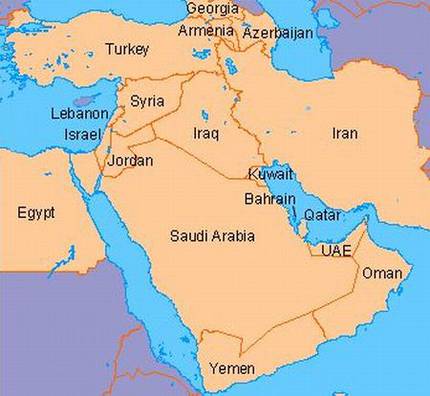
National boundaries today. Graphic from www.hotelsinthemiddleeast.com

So the boundaries of the Middle East nations are suddenly being exposed as fragile and arbitrary as they are - the real challenge is governance. Have the Kurds, based on their relatively sound governance in the midst of a broken Iraq, suddenly found an opening to assert their own entity?

Just for fun, here's how a map of the Middle East might look if it were more representative of major ethnic groupings. Click on the image to see a larger, more readable version.


Ralph Peters, a former United States Army Lieutenant Colonel drew a map in 2006, which created quite an outcry at the time. But note, according to a post at www.geographictravels.com "how the proposal for Syria mirrors what is going on now with the Kurds going their own way and the coastal area becoming an Alawite enclave aligned with Hizbollah in Lebanon." Graphic from www.geographictravels.com

Porous borders

We've talked at length in various posts about refugees and internally displaced peoples around the world and in trouble spots. But the borders Teatree speaks of is in regard to the many young ISIS jihadists from across Europe who have gone to the Middle East, gaining expertise in killings and mayhem, and who also have passports to return home. While ISIS currently terrorizes the lands of Syria and Iraq (both likely to disintegrate), the concern of Western and indeed other Muslim nations' intelligence agencies is how to track hundreds of fighters who hold the option of returning to their own lands over the next few years.

British Islamists protest outside the French Embassy in London January 12, 2013. Reuters. Photo from rt.com


Possible returnees by the numbers. Graphic from USNews.com


In the UK, according to an article in www.jihadwatch.org, "Communities have been bombarded with the posters, which read: “˜You are entering a Sharia-controlled zone ““ Islamic rules enforced.” The bright yellow messages daubed on bus stops and street lamps have already been seen across certain boroughs in London and order that in the “˜zone” there should be “˜no gambling”, “˜no music or concerts”, “˜no porn or prostitution”, “˜no drugs or smoking” and “˜no alcohol”." Photo from www.jihadwatch.org

The cauldron continues to roil, the heat is still rising.

Sunday, June 29, 2014

Refugees and other flows from regional conflicts grow

"The first casualty, when war comes, is truth" is a statement that has been often repeated and modified. It is attributed to Hiram Johnson (1866-1945), a "staunchly isolationist" Republican senator from California in reference to World War 1. (Hmmm, the 100th anniversary of what is considered the precipitant act of that war was held this week. As the Australian Broadcasting Service (ABC) concisely summarizes, "the Archduke Ferdinand - the heir to the Austro-Hungarian throne - was shot dead with his wife Sophie on a June morning in 1914. Ferdinand's murder by Gavriol Princip, a 19-year-old Bosnian Serb, set the Great Powers marching to war. More than 10 million soldiers died, as empires crumbled and the world order was rewritten.")

Click on image for full picture
Yes, the 100th year commemoration of the assassination, carried out by the Bosnian, Gariol Princip, was held in Sarajevo, Bosnia and Herzegovina, but not without controversy!. Apparently the killing is seen very differently by Bosnians, Croats, and Serbs. To some in Bosniak parts of the country, Princip was a terrorist; to some Serbs, he is largely viewed as an ethnic Serb nationalist, while others see in him a pan-Slav idealist. In this picture by the BBC, a Serbian flag is carried in the eastern B-H town of Visegrad at a separate commemoration more sympathetic of Princip.

So where was I? Teatree's POINT is that one could come up with other firsts besides truth being the first casualty. While there is little doubt that truth is quick to go - yes, yes, and yes - Teatree observes that the wrenching of civilians from their homes may even come sooner.

Three refugee flows

Inside Iraq

We've read much of Syria's streams of civilians heading to Turkey and Jordan - hundreds of thousands - and some were even a couple years ago fleeing to Iraq. But with ISIS in Syria and Iraq making the news this past two weeks, tens of thousands of Iraqis themselves are fleeing in all directions - mainly to safe parts of their now divided country.

Click on image for full picture
Iraqis from Mosul fled everywhere, but many into the autonomous Kurdish controlled region. Photo from redstate.com

Between Russia and the Ukraine

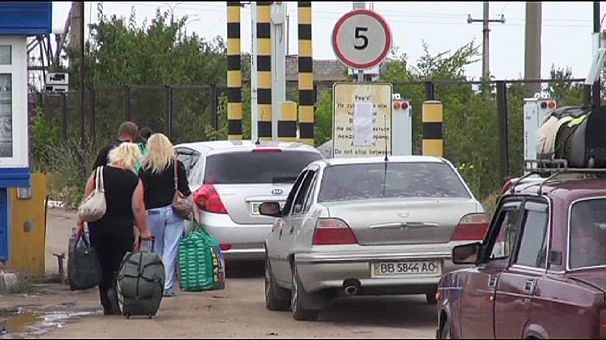
There are thousands on the roads in Eastern Ukraine. Some are heading to Russia or pro-Russian strongholds in the east of the country, while some Eastern Ukrainians are headed west to safer Ukrainian territory. The UN puts a number on internal movements - 54,000 - but notes that another 110,000 Ukrainians have gone to Russia since the first of the year.

Click on image for full picture
Pro-Russian civilians (or those simply concerned for their families' safety) going through border crossing into Russia. Photo from www.euronews.com

From Central America to the U.S.

There isn't exactly a war or conflict going on in several Central American countries - Honduras, El Salvador, Guatemala, - but it is clearly a desperate situation that stems from poverty, the rise of gangs, and violence of drug cartels in these small nations. What is unique is that children are being sent on their own to the U.S., no doubt assuming the U.S. is much less likely to return children than it would adults traveling alone.

Click on image for full picture
Central American families (not strictly just children) arriving in great numbers. An ABC article states, "The Department of Homeland Security says more than 52,000 unaccompanied minors have been detained along the U.S. border with Mexico this fiscal year. In addition, authorities have apprehended 39,000 adults with small children. The numbers reflect a significant uptick over last year, when just 24,000 unaccompanied minors were apprehended. The majority in the surge hail from Central American countries, and a disproportionate number are young women and under age 13, officials say." Photo from rt.com

Click on image for full picture
Countries under great stress, and parents sending children north Graphic from Mother Jones.com

One other flow

We've seen it before: in Libya after the overthrow of Gaddafi, unsecured weaponry flooded North African countries, and many say these weapons fueled the uptick of strength in Boko Haram and was responsible for the surge of conflict in Mali.

Today, a new flood of weapons is on the move. In Iraq, vast amounts of weaponry, along with vehicles and armor, changed hands. It came from Iraqi army units that melted in front of ISIS fighters, and immediately seized by ISIS itself.

Click on image for full picture
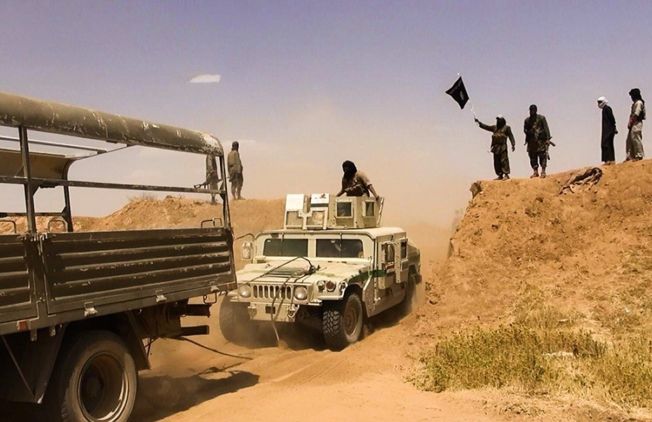
This graphic shows, if nothing else, that the border between Iraq and Syria is for now, a moot boundary. A sand berm that once delineated the line was bulldozed out by ISIS forces. ISIS or ISIL? These are Western terms, the militants refer to themselves as simply jihadis for "al-Dawla", Arabic for the State. That's the main point, they don't view the Syrian or Iraq boundaries as significant, as they are trying to establish their own Caliphate. Graphic from the BBC

Click on image for full picture
Not "just" small arms, but vehicles, tanks, missiles - and in many cases American made - have passed into ISIS hands. These incidentally are coming through early breaks in the sand berm that once delineated Syria from Iraq. Photo from www.vg.no

And so they go ...


Monday, June 16, 2014

Iraq, left on its own, backed to the edge

The news from Iraq this week has been bad. Very bad. A growing body of Islamic extremists, gathered from a territory carved out of Eastern Syria during the ongoing Syrian civil war, calling themselves the Islamic State of Iraq and Syria (ISIS), has exploded into Sunni lands in eastern Iraq.

Taking advantage of the poor and divisive governance by Iraqi leader Maliki, ISIS has played on the resentment of Sunnis, chasing a shocked Iraqi army from several cities including Iraq's second largest city, Mosul.

The interesting presentation in this BBC graphic, shows thin little yellow lines as the controlled territory of ISIS. What is really is showing is that the Iraqi population and cities of Western Iraq are for the most part along waterways, the vacant land inbetween is simply empty desert.

Click on image for full picture
Al Raqqa, Syria, has long been in the hands of anti-Assad rebels, and has become, unfortunately, the urban headquarters for ISIS, one of the most ruthless factions of Islamic extremists. Photo from www.timesofisrael.com

So, the first point suggested by Teatree to muse upon, is that due to Western inaction to support moderate Syrian opposition, extremists have consolidated their control of the anti-Assad forces. Not only do they want to remove Assad - the chemical weapons user who has just manipulated his third Presidential term - but more importantly establish their own "Caliphate." Just as the Taliban gained an actual footprint in ruling Afghanistan in the 1990s, ISIS now has a base, and it has gained it in the middle of the Syrian civil war.

Iraq, left to itself, sinks into sectarianism

In the West, the US and UK in particular, the shocking collapse of Iraq has quickly degenerated to large degree into a rehash of whether President Bush and Prime Minister Tony Blair are either completely, or mainly to blame.

What can at least be said is that Iraqi President Maliki has done nothing, really, to attempt to create a big house government, including Sunnis and the Kurds in the past 8 or so years. Becoming more sectarian, ie, favoring his fellow Shiites, Maliki has by neglect lost most of the country (For a detailed description of Maliki's rule, read the New York Time link in the comment section). The Sunnis are hostile, and unfortunately choosing badly in accepting (or tolerating) ISIS gains. The Kurds, on the other hand, have never felt part of a national Iraqi identity, and in the midst of this recent chaos have quickly moved to consolidate their hold on Kurd land in Northeast Iraq.

Click on image for full picture
Kurds have consolidated their hold in Iraq's northeast, Sunnis have marginalized themselves to the west, and dabble dangerously with ISIS (or alternatively ISIL), while the Shia homeland in SE Iraq is in danger of becoming a vassal of Shia Iran. Graphic taken from a CBC.ca article

One point of debate

US President Obama, fulfilling a political campaign promise, quickly pulled all US troops out of Iraq within three years of being in office. One could say, and many do, that he left a fragile - clearly fragile - nascent democracy surrounded by hostile or indifferent neighbors and plenty of internal strife. Yet no stabilizing force at all could be left there, the White House explains, because the two countries could not agree on future immunity for US forces if they were to remain in the country. Teatree will only point out that it seems the US was excruciatingly polite in negotiations to so quickly give in to this one country. Given the US propensity during the same time and continuing to this day, to strike targets repeatedly at will with drones in Pakistan, Afghanistan, Yemen, and Somalia, with or without those nation's official approval, one can only wonder whether a political promise was the major reason for such a complete hasty Iraqi withdrawal, regardless of the consequences which we are now witnessing.

In contrast, after the Balkan war ended in the mid-90s, nearly 50,000 NATO troops stayed to ensure the peace, building fragile bridges between wounded and wary ethnic populations for several years, before slowly winding down their presence. Even today, 20 years later, over 5000 troops remain. One could highlight the value of stabilizing forces in South Korea, Japan, and even Germany for decades, but that would belabor the point.

KFOR troops in Kosovo, keeping the fragile peace between neighboring Serbia and Muslim Kosovans, and earlier between a number of nations, Croatia, Republic of Bosnia and Herzegovina, Slovenia, etc. Photo from fredbellomy.com

Iran steps closer to Shia arc
Iran, already pleased with Maliki in Iraq, have offered him assistance in fighting ISIS. With this opening to create a closer relationship with Iraq, Iran moves towards its long term goal of establishing an arc of influence: from Iran into Syria where it supports Assad, and linking with Hezbollah in Lebanon. Now with Iraq on the edge, the possibility of an uninterrupted arc is within reach. And while Russia has robustly supported chemical-weapons man Assad in Syria, in contrast the West timidly continues its searches for appropriate groups it might support among the Syrian opposition. (Hint - these moderate groups have long since left the building ...).

The current three - Hezbollah's Nasrullah, left; Iran's Rouhani, center; and chemical-man Assad from Syria on the right. Suddenly the three buddies have half of Iraq in their pocket, with just ISIS rabble to clear out in-between. Poster photo from irannewsupdate.com

What's ahead?
Aside from sectarian bloodletting on a scale we've not seen yet even in Syria or during the US occupation of Iraq, we are possibly seeing a preview of what lies ahead in Afghanistan as soon as the US pulls its combat troops out by the end of this year, and even the trailing training force of 10,000 within a year after that.

What else? Under this current US administration, the West is likely to retreat to a limp posture of the past - lobbing a few tomahawk missiles here and there, and launching more drone strikes safely from a distance, though no doubt without anyone's permission. That fastidiousness of gaining permission was reserved for the former Iraq alone.

Click on image for full picture
Drone strikes are apparently the US default strategy (permission granted or not), with no chance for immediate battlefield death or injury for US armed forces. But doesn't it appear that the U.S. might be losing a bit of the "hearts and minds" battle? Photo from org.salsalabs.com

Certainly there will be no large scale commitment of US combat troops back into the Iraqi theater - that ship has sailed. Though how US troops in Kuwait will somehow remain exempt from extremist attacks remains to be seen. And our erstwhile allies Jordan and Israel may also believe our reassurances of steadfast US support leaves something to be desired.

And onward the world moves ...