One of the "horrors" of our modern accessibility to world events, is the excruciating minute by minute - it seems - witnessing of violence, and way too much time to ponder the mystifying selectivity of what is or is not covered by media, much less what is or is not addressed by the world.
Syria and its neighbors
Syria's daily reports of armed forces shelling and blasting civilian populations is both numbing and frustrating. In the eleven months since an "Arab spring" of sorts emerged in this country, the government of Bashar al-Assad has sought to crush opposition, first in a sort of "whack a mole" strategy, but increasingly with more deadly fire. The death toll in Syria is now over 5,000 (Saudi Arabia lists it as over 7,000), far past the trigger of 1,000 to 2,000 which moved the West to take on Libya's now-deceased Gadaffi.
A map of Syria, showing the major cities and where protests have centered. It is outdated in that deaths have now occurred about everywhere as well as what might be classified as major protests.
Click on image for full picture
Egyptian bloggers are paying attention as well. This from an Egyptian woman, with the dark brown representing blood where martyrs have died.
The framework and timeline of Syria's conflict seem clear enough:
In early 2011, Bashar al-Assad's regime, based from within its own minority Alewite tribe, was busy with its longstanding, business-as-usual hostile stance against Israel, while continuing its quiet domination of neighboring Lebanon through its proxy ally Hezbollah. With a certain amount of status in the Arab world (Syria was a founder of the Arab League), it maintained neighborly relations with Turkey to the north, Russia on the international power scene, and content within its informal regional alliance with its strong supporter Iran.
Bashar (center) with his buddies, the holocaust-denying Iranian President Mahmoud Ahmadinejad (left), and Hezbollah leader Hassan Nasralla.
Then came the Arab spring. Syria watched warily as the protests erupted in a handful of countries in the region (Yemen, Bahrain, Morocco, Jordan, Saudi Arabia, Libya, Tunisia, Egypt), and brought about the downfall of leaders in Tunisia and Egypt. As the West intervened in Libya, Assad chose to deal harshly with its own set of protestors - hoping to "nip it in the bud," as we would say.
Bashar al-Assad has long carefully cultivated a modern Western image, buttressed by his young attractive wife, Asma. (Asma's dress of course would not be acceptable or comparable to his buddies' wives.)
By June, however, a new pattern was becoming clear. Protests were not dwindling, and each death of a protestor resulted in a funeral that fanned flames further. Each Friday's day of prayers resulted in a new wave of protests, and Assad was loosening his rules of engagement for his security forces, including the murkily-linked go-ahead given to the feared Shabiha - a militia of thugs who had long run protection rackets, weapons and drug-smuggling rings, and other criminal enterprises in cities along the Mediterranean. And in June for the first time, the Arab League formally expressed its disapproval of Syria's actions against its own people.
Today, after eight months of steadily escalating violence, Syria is isolated, saved on the international scene only by predictable self-serving votes in the UN by Russia and China, who wish to avoid any precedent for nations to intervene or condemn what is sacrosanct - how a government conducts its internal affairs. The Arab League has now taken a stand against the present regime of Syria, calling for it to step down, and the U.N. General Assembly voted overwhelmingly (The vote in the 193-member world body on the Arab-sponsored resolution was 137-12 with 17 abstentions) for a resolution backing an Arab League plan calling for the Syrian President to step down while strongly condemning human rights violations by his regime.
Click on image for full picture
Voting in the UN General Assembly condemning Syria for its repression. Let's be clear on who voted against the resolution, the language of which can be found at the UN website(www.un.org/News/Press/docs//2012/ga11207.doc.htm). The votes against were from Belarus, Bolivia, China, Cuba, Democratic People’s Republic of Korea, Ecuador, Iran, Nicaragua, Russian Federation, Syria, Venezuela, Zimbabwe
Turkey, Syria's neighbor to the north, is strengthened the guarding of its common border, providing refuge to those able to flee, and providing de facto protection to what some observers note are armed resisters. Jordan to the south is also now building refugee camps for those civilians fleeing Syrian violence.
Bashar al-Assad had at one time a 270,000 person security force, but according to Turkish intelligence, about 40,000 have deserted, and over 2500 soldiers have joined the opposition Free Syrian Army. The notorious Shabiha of June has become just one of many violent groups now tearing at what remains of the country's societal fabric.
The West, led by the US and the UK are becoming more free with undiplomatic language towards Syria and its UN supporters China and Russia. The latest was Secretary of State Hillary Clinton's use of the word "despicable" when it came to these two countries votes in support of Syria. Syria outraged the West again this past few days when it deliberately shelled a makeshift press center, killing two well respected journalists.
Click on image for full picture
Marie Colvin was one of two journalists killed in what is described as deliberate targeting by Syrian forces. Colvin lost an eye while reporting on the civil war in Sri Lanka back in 2001. With due respect, the other journalist killed was a younger man, French photographer Remi Ochlik.
But words are just that. And the conflict and death toll could get much worse, so the average westerner at least, will likely be bombarded with random images and stories on a daily basis for the foreseeable future.
It is a sobering statistic to note that in the Libyan spring, which morphed into a western intervention, that in just six months, at least 30,000 people were killed and 50,000 wounded. In September, 2011, Naji Barakat, Libya's interim health minister, offered this first detailed estimate of the high cost in lives of bringing down Gadaffi. Barakat said at the time he expected the final figure for dead and wounded to be higher than his current estimate. But the world has since moved on - by and large deeming the intervention a success, the "smart way" to win a war - and more than a casual search on the internet unearths no further updates on casualties after the September assessment.
Click on image for full picture
This neighborhood apartment complex in the city of Homs, pocked by Syrian shells and bullets.
This is a big world, we happen to have been born into a dominant country, itself part of a prosperous and powerful Western civilization. We're "oversupplied" with news though it may not inform us well. "Six stories from seven continents" is a modest effort to remind ourselves there are snippets, events, and stories from all around the world to hear and learn from... that our awareness is incomplete, and life is breathtakingly more complex and wonderful than we usually imagine.
North Korea
The always bombastic and unpredictable North Koreans go hysterical again. This time the country is prepared to "go to war" with South Korea because that country is playing loudspeakers directed at North Korean territory. A headline from a UK paper reads, "More than 50 North Korea submarines 'leave their bases' as war talks with South continue "
Saturday, February 25, 2012
Saturday, February 18, 2012
The Russian election and a vote on the Russian language
A Russian Presidential election is scheduled for March 4, 2012
In two weeks, Russia has elections which will determine the new President and Prime Minister. Yesterday according to Reuter's article, pro-Prime Minister Vladimir Putin rallies were held from one end of the country to the other, aimed at showing that Mr. Putin, who could remain president until 2024 if he wins two straight terms, has majority support despite the biggest opposition protests of his 12-years of ruling positions.
Tens of thousands of people have turned out for opposition protests in recent months, venting anger over suspected fraud in December's parliamentary election, and over what they see as a lack of say in Putin's tightly controlled political system. In those December elections, Prime Minister Vladimir Putin's United Russia party won less than 50 percent of Sunday's vote, a steep fall from its earlier two-thirds majority.
None the less, it appears likely Putin will once again take on the role of President in the country, with his emphasis on nationalism, order and control, and a loss of momentum for a broader, more democratic public square.
Pro-Putin rally in Moscow
The discontent runs deep. From the BBC, we read that "parts of Russia, including many of the big cities, have turned against Mr Putin's United Russia, which opponents have nicknamed the "party of crooks and thieves".
Novosibirsk, for example, Russia's third-largest city, returned one of the lowest votes for United Russia in December's parliamentary elections. The ruling party was beaten into second place by the Communists in every district of the city.
As in many places in Russia, the big issue in Novosibirsk is corruption, which now affects much of people's lives. However, according to the BBC article, citizens have stopped just blaming local officials who they believe are stealing from them, and have started blaming Moscow ...
Far from Moscow, the wintry-looking city of Novosibirsk does not share the same enthusiasm for Putin
A money-grab by some officials in this region seems to be particularly galling. In the Novosibirsk region even veterans of the "Great Patriotic War" - as World War II is called in Russia - have been taken advantage of. Russian veterans are revered, and in the last few years there has been a scheme to provide the few surviving soldiers from the war with new housing. But some officials appear to have used the sentiment and program as a way of enriching themselves.
Under the veterans' housing scheme, one such veteran, Ivan Uvarov, qualified for a grant of 5m roubles - more than $150,000. (During the war he was an engineer, and walked all the way to Berlin, accompanying infantry as they fought their way to the German capital.) In his old age, he was entitled to choose his new home, and dreamed of buying a traditional wooden Siberian house in his village.
But some local officials persuaded him to accept a tiny one-room flat in a block built for veterans out of bricks from a factory owned by one of the officials. Anti-corruption campaigners believe the flat was worth half of the 5m roubles Mr. Uvarov had been awarded. And no-one knows where the rest of the money went.
Ivan Uvarov, and perhaps(?)his daughter ...
So, although unrest and resistance to the current level of integrity in governance rising across the sprawling country, the March 4 Russian election seems unlikely to change much or herald any form of a "Russian spring."
Latvia votes against adding Russian as a second language.
Today, Latvia voters decided against adding Russia as a second official language in their small country. Again, from the BBC, "Ethnic Russians, who make up about one-third of Latvia's population, had long complained of discrimination. But many ethnic Latvians believed the referendum was an attempt to encroach on the country's independence.
Click on picture for full image
Latvia is one of the three Baltic states shown here on the map, which gained independence from Moscow in 1991 after half-a-century of Soviet rule. It joined the European Union in 2004.
Latvia, with a population of just 2.2 million, is the middle Baltic country, sandwiched between Estonia to the north, Lithuania to the south.
The referendum was initiated by the Russian-speakers' movement, Native Tongue, which collected signatures from more than 10% of voters to force a ballot. "I think that over the past 20 years Russian residents of Latvia have been humiliated by authorities, by endless attempts either to assimilate or make them second-class citizens," said Vladimir Linderman, co-chairman of Mother Tongue, to the Associated Press, "So this is our answer."
If it was the answer, it wasn't likely to be the one Russians wanted. Officials said that with more than 90% of votes counted, 75% of votes cast in Saturday's referendum were against the proposal.
The voting booths in Latvia were busy with a strong turnout for the second language referendum
Learning Latvian was a prerequisite for citizenship in the years after the country split from the Soviet Union two decades ago. But many Russian-speakers resisted, and some 300,000 remain without citizenship, which means they cannot vote in elections, hold public office or work in government institutions, according to some reports.
The referendum had been described as "absurd" by Latvian President Andris Berzins, who said most people were more concerned with the country's recovery from a severe recession. He pointed out that the government funds own-language schools for minority groups such as Russians. "There's no need for a second language. Whoever wants, can use their language at home or in school," he said.
Riga is the 1000 year old capitol of Latvia, nestled along the Daugava River, originating 630 miles back east in mountains of Russia, and ending in the Baltic Sea.
Language is always an issue of identity in countries. Latvian, sometimes referred to as Lettish, is the official state language of Latvia. According to Wikipedia, there are about 1.4 million native Latvian speakers in country and about 150,000 abroad. Because of the language policy in Latvia about 1.9 million or 79% of Latvian population speak Latvian. (Of interest, the US has no official language, much less two as desired in Latvia by an apparently small minority.)
In two weeks, Russia has elections which will determine the new President and Prime Minister. Yesterday according to Reuter's article, pro-Prime Minister Vladimir Putin rallies were held from one end of the country to the other, aimed at showing that Mr. Putin, who could remain president until 2024 if he wins two straight terms, has majority support despite the biggest opposition protests of his 12-years of ruling positions.
Tens of thousands of people have turned out for opposition protests in recent months, venting anger over suspected fraud in December's parliamentary election, and over what they see as a lack of say in Putin's tightly controlled political system. In those December elections, Prime Minister Vladimir Putin's United Russia party won less than 50 percent of Sunday's vote, a steep fall from its earlier two-thirds majority.
None the less, it appears likely Putin will once again take on the role of President in the country, with his emphasis on nationalism, order and control, and a loss of momentum for a broader, more democratic public square.
Pro-Putin rally in Moscow
The discontent runs deep. From the BBC, we read that "parts of Russia, including many of the big cities, have turned against Mr Putin's United Russia, which opponents have nicknamed the "party of crooks and thieves".
Novosibirsk, for example, Russia's third-largest city, returned one of the lowest votes for United Russia in December's parliamentary elections. The ruling party was beaten into second place by the Communists in every district of the city.
As in many places in Russia, the big issue in Novosibirsk is corruption, which now affects much of people's lives. However, according to the BBC article, citizens have stopped just blaming local officials who they believe are stealing from them, and have started blaming Moscow ...
Far from Moscow, the wintry-looking city of Novosibirsk does not share the same enthusiasm for Putin
A money-grab by some officials in this region seems to be particularly galling. In the Novosibirsk region even veterans of the "Great Patriotic War" - as World War II is called in Russia - have been taken advantage of. Russian veterans are revered, and in the last few years there has been a scheme to provide the few surviving soldiers from the war with new housing. But some officials appear to have used the sentiment and program as a way of enriching themselves.
Under the veterans' housing scheme, one such veteran, Ivan Uvarov, qualified for a grant of 5m roubles - more than $150,000. (During the war he was an engineer, and walked all the way to Berlin, accompanying infantry as they fought their way to the German capital.) In his old age, he was entitled to choose his new home, and dreamed of buying a traditional wooden Siberian house in his village.
But some local officials persuaded him to accept a tiny one-room flat in a block built for veterans out of bricks from a factory owned by one of the officials. Anti-corruption campaigners believe the flat was worth half of the 5m roubles Mr. Uvarov had been awarded. And no-one knows where the rest of the money went.
Ivan Uvarov, and perhaps(?)his daughter ...
So, although unrest and resistance to the current level of integrity in governance rising across the sprawling country, the March 4 Russian election seems unlikely to change much or herald any form of a "Russian spring."
Latvia votes against adding Russian as a second language.
Today, Latvia voters decided against adding Russia as a second official language in their small country. Again, from the BBC, "Ethnic Russians, who make up about one-third of Latvia's population, had long complained of discrimination. But many ethnic Latvians believed the referendum was an attempt to encroach on the country's independence.
Click on picture for full image
Latvia is one of the three Baltic states shown here on the map, which gained independence from Moscow in 1991 after half-a-century of Soviet rule. It joined the European Union in 2004.
Latvia, with a population of just 2.2 million, is the middle Baltic country, sandwiched between Estonia to the north, Lithuania to the south.
The referendum was initiated by the Russian-speakers' movement, Native Tongue, which collected signatures from more than 10% of voters to force a ballot. "I think that over the past 20 years Russian residents of Latvia have been humiliated by authorities, by endless attempts either to assimilate or make them second-class citizens," said Vladimir Linderman, co-chairman of Mother Tongue, to the Associated Press, "So this is our answer."
If it was the answer, it wasn't likely to be the one Russians wanted. Officials said that with more than 90% of votes counted, 75% of votes cast in Saturday's referendum were against the proposal.
The voting booths in Latvia were busy with a strong turnout for the second language referendum
Learning Latvian was a prerequisite for citizenship in the years after the country split from the Soviet Union two decades ago. But many Russian-speakers resisted, and some 300,000 remain without citizenship, which means they cannot vote in elections, hold public office or work in government institutions, according to some reports.
The referendum had been described as "absurd" by Latvian President Andris Berzins, who said most people were more concerned with the country's recovery from a severe recession. He pointed out that the government funds own-language schools for minority groups such as Russians. "There's no need for a second language. Whoever wants, can use their language at home or in school," he said.
Riga is the 1000 year old capitol of Latvia, nestled along the Daugava River, originating 630 miles back east in mountains of Russia, and ending in the Baltic Sea.
Language is always an issue of identity in countries. Latvian, sometimes referred to as Lettish, is the official state language of Latvia. According to Wikipedia, there are about 1.4 million native Latvian speakers in country and about 150,000 abroad. Because of the language policy in Latvia about 1.9 million or 79% of Latvian population speak Latvian. (Of interest, the US has no official language, much less two as desired in Latvia by an apparently small minority.)
Sunday, February 12, 2012
Perhaps not news, but newsworthy
With the continuing story of Syria possibly descending into civil war (the only entity exalting and calling for war is Al-qaeda), the equation of what does it take to make the West choose sides and intervene or not remains a mystery.
So, let's move on to a subject that is newsworthy, though most of the time is not news. Here are four organizations around the world working to better the lives of people. There are, of course, hundreds more - humanitarian and religious efforts that toil in obscurity, and perhaps even more than a few who do so without well-thought through plans. But for the main, they have one thing in common - they don't make the news that often, yet by and large, help heal and care for humanity in need.
Bill and Melinda Gates Foundation www.gatesfoundation.org
Click on image for full picture
Two major emerging countries (India and China) have, probably by no coincidence, large foundation programs. On January 13, 2012, India marked one-year without detecting a single case of wild poliovirus; a major success for polio eradication and for child health. Here vaccination teams prepare for a day of work
Perhaps the most compelling aspect of this organization is that the founder of Microsoft, Bill Gates, and his wife Melinda, have made it their new focus to give away the billions they have received from their world changing emergence of computers and software. Of the 15 guiding principles for this foundation that has now given away billions, the following 5 are highlighted:
Guiding Principle #9: We must be humble and mindful in our actions and words. We seek and heed the counsel of outside voices.
Guiding Principle #10: We treat our grantees as valued partners, and we treat the ultimate beneficiaries of our work with respect.
Guiding Principle #11: Delivering results with the resources we have been given is of the utmost importance—and we seek and share information about those results.
Guiding Principle #12: We demand ethical behavior of ourselves.
Guiding Principle #13: We treat each other as valued colleagues.
The foundation to date has, with its large resources, made significant impact in "health problems that have a major impact in developing countries but get too little attention and funding. Where proven tools exist, we support sustainable ways to improve their delivery. Where they don’t, we invest in research and development of new interventions, such as vaccines, drugs, and diagnostics. Our work in infectious diseases focuses on developing ways to fight and prevent enteric and diarrheal diseases, HIV/AIDS, malaria, pneumonia, tuberculosis, and neglected and other infectious diseases. We also work on integrated health solutions for family planning, nutrition, maternal, neonatal and child health, tobacco control and vaccine-preventable diseases. "
Click on image for full picture
Linda Venczel, senior program officer with the Bill and Melinda Gates Foundation, and Yang Xiaoming, general manager of China National Biotech Group sign the cooperation agreement in Beijing on June 10, 2011 regarding polio eradication. The foundation also works on HIV/AIDs programs in China
Medecins Sans frontieres www.doctorswithoutborders.org
Doctors Without Borders/Médecins Sans Frontières (MSF) is an international medical humanitarian organization created by doctors and journalists in France in 1971. MSF provides independent, impartial assistance in more than 60 countries to people whose survival is threatened by violence, neglect, or catastrophe, primarily due to armed conflict, epidemics, malnutrition, exclusion from health care, or natural disasters. MSF provides independent, impartial assistance to those most in need. MSF also reserves the right to speak out to bring attention to neglected crises, challenge inadequacies or abuse of the aid system, and to advocate for improved medical treatments and protocols. In 1999, MSF received the Nobel Peace Prize.
Click on picture for full image
The availability of clean water in Juba, South Sudan, is still scarce. Here, women wash clothes and dishes in the White Nile, and very likely, the yellow containers are to haul drinking water. Properly-designed wells delivering clean drinking water are the priority
Click on picture for full image
In India, MSF works on a complex disease called Kala Azar. Symptoms of kala azar include fever, loss of appetite, enlarged spleen and liver, and anemia. Infection occurs when the kala azar parasite is transmitted through the bite of a sand fly. Symptoms usually appear around two weeks after the bite. Here a hospital ward treats young victims
Danish Demining Group www.danishdemininggroup.dk
This group made the news a few weeks ago, when two of their workers in Somalia were rescued after being held as hostages for three months. The organization is funded mainly by Western democracies, and currently works in 10 countries around the world where mines have been sown in past conflicts:
Afghanistan
Colombia
Iraq
Liberia
Somaliland
South/Central Somalia and Puntland
Sri Lanka
South Sudan
Uganda
Yemen
Sri Lanka still littered with mines from a decades long civil war
Their work is centered on a community approach, and most 95% of its employees are local, with a few technical experts for training. Their principles are based on a "Value Compass" established by the Danish Refugee Council:
* Humanitarian approach - people´s right to a life with dignity takes precedence over politics and principles
* Respect - for the equal rights of human beings
* Independence and neutrality - in regard to our surroundings
* Inclusion - of the people we work to help
* Honesty and transparency - for all beneficiaries, donors, partners and others
Working to clear land with the advice of Afghan elders
Heifer Project International www.heifer.org
This well known organization seems to be particularly easy for young children to relate to, as small animals are at the heart of the program designed for families. Of the five cornerstones of the organization, two stand out.
Sustainability and Self-Reliance, and Passing on the Gift.
"Passing on the gift" is fundamental to Heifer's entire approach. As people share the offspring of their animals – along with their knowledge, resources, and skills – an expanding network of hope, dignity and self-reliance is created that reaches around the globe. "Passing on the Gift" creates a living cycle of sustainability that develops community and enhances self-esteem by allowing project partners to become donors.
Heifer Project International is the outgrowth of one man with a vision and a practical method of implementation that did not require inordinate financial underwriting. Born a native of Ohio in 1893, Dan West, a life-long Brethren graduated from Manchester College in 1917 and spent the next two years as a conscientious objector during World War I. After working for the Emergency Peace Campaign in 1936 he traveled to Spain in order to serve as a relief worker following the Spanish Civil War. His vision was based on Luke 6:38 “Give, and it shall be given unto you; good measure, pressed down, and shaken together, and running over, shall men give into your bosom. For with the same measure that ye mete withal it shall be measured to you again.”
Based in Little Rock Arkansas, the organization has helped more than 13.6 million families (71 million people) in more than 125 countries.
Bees from Heifer International help struggling families earn income through the sale of honey, beeswax and pollen. Beehives require almost no space, and once established, are inexpensive to maintain. As bees search for nectar, they pollinate plants. Placed strategically, beehives can as much as double some fruit and vegetable yields. In this way, a beehive can be a boon to a whole village. Although most Heifer partners keep bees as a supplement to family income, beekeeping can be a family's livelihood.
Salajan Sergiu Constantin, 5, feeds alfalfa recently cut from a nearby field to the family cow Mandruta on the family farm in the village of Giurtelecul Simleului, Romania. "Every day I bring fresh grass or the cow will get sick." Photo by David Snyder, courtesy of Heifer International June 2009
Newsworthy, not necessarily news.
So, let's move on to a subject that is newsworthy, though most of the time is not news. Here are four organizations around the world working to better the lives of people. There are, of course, hundreds more - humanitarian and religious efforts that toil in obscurity, and perhaps even more than a few who do so without well-thought through plans. But for the main, they have one thing in common - they don't make the news that often, yet by and large, help heal and care for humanity in need.
Bill and Melinda Gates Foundation www.gatesfoundation.org
Click on image for full picture
Two major emerging countries (India and China) have, probably by no coincidence, large foundation programs. On January 13, 2012, India marked one-year without detecting a single case of wild poliovirus; a major success for polio eradication and for child health. Here vaccination teams prepare for a day of work
Perhaps the most compelling aspect of this organization is that the founder of Microsoft, Bill Gates, and his wife Melinda, have made it their new focus to give away the billions they have received from their world changing emergence of computers and software. Of the 15 guiding principles for this foundation that has now given away billions, the following 5 are highlighted:
Guiding Principle #9: We must be humble and mindful in our actions and words. We seek and heed the counsel of outside voices.
Guiding Principle #10: We treat our grantees as valued partners, and we treat the ultimate beneficiaries of our work with respect.
Guiding Principle #11: Delivering results with the resources we have been given is of the utmost importance—and we seek and share information about those results.
Guiding Principle #12: We demand ethical behavior of ourselves.
Guiding Principle #13: We treat each other as valued colleagues.
The foundation to date has, with its large resources, made significant impact in "health problems that have a major impact in developing countries but get too little attention and funding. Where proven tools exist, we support sustainable ways to improve their delivery. Where they don’t, we invest in research and development of new interventions, such as vaccines, drugs, and diagnostics. Our work in infectious diseases focuses on developing ways to fight and prevent enteric and diarrheal diseases, HIV/AIDS, malaria, pneumonia, tuberculosis, and neglected and other infectious diseases. We also work on integrated health solutions for family planning, nutrition, maternal, neonatal and child health, tobacco control and vaccine-preventable diseases. "
Click on image for full picture
Linda Venczel, senior program officer with the Bill and Melinda Gates Foundation, and Yang Xiaoming, general manager of China National Biotech Group sign the cooperation agreement in Beijing on June 10, 2011 regarding polio eradication. The foundation also works on HIV/AIDs programs in China
Medecins Sans frontieres www.doctorswithoutborders.org
Doctors Without Borders/Médecins Sans Frontières (MSF) is an international medical humanitarian organization created by doctors and journalists in France in 1971. MSF provides independent, impartial assistance in more than 60 countries to people whose survival is threatened by violence, neglect, or catastrophe, primarily due to armed conflict, epidemics, malnutrition, exclusion from health care, or natural disasters. MSF provides independent, impartial assistance to those most in need. MSF also reserves the right to speak out to bring attention to neglected crises, challenge inadequacies or abuse of the aid system, and to advocate for improved medical treatments and protocols. In 1999, MSF received the Nobel Peace Prize.
Click on picture for full image
The availability of clean water in Juba, South Sudan, is still scarce. Here, women wash clothes and dishes in the White Nile, and very likely, the yellow containers are to haul drinking water. Properly-designed wells delivering clean drinking water are the priority
Click on picture for full image
In India, MSF works on a complex disease called Kala Azar. Symptoms of kala azar include fever, loss of appetite, enlarged spleen and liver, and anemia. Infection occurs when the kala azar parasite is transmitted through the bite of a sand fly. Symptoms usually appear around two weeks after the bite. Here a hospital ward treats young victims
Danish Demining Group www.danishdemininggroup.dk
This group made the news a few weeks ago, when two of their workers in Somalia were rescued after being held as hostages for three months. The organization is funded mainly by Western democracies, and currently works in 10 countries around the world where mines have been sown in past conflicts:
Afghanistan
Colombia
Iraq
Liberia
Somaliland
South/Central Somalia and Puntland
Sri Lanka
South Sudan
Uganda
Yemen
Sri Lanka still littered with mines from a decades long civil war
Their work is centered on a community approach, and most 95% of its employees are local, with a few technical experts for training. Their principles are based on a "Value Compass" established by the Danish Refugee Council:
* Humanitarian approach - people´s right to a life with dignity takes precedence over politics and principles
* Respect - for the equal rights of human beings
* Independence and neutrality - in regard to our surroundings
* Inclusion - of the people we work to help
* Honesty and transparency - for all beneficiaries, donors, partners and others
Working to clear land with the advice of Afghan elders
Heifer Project International www.heifer.org
This well known organization seems to be particularly easy for young children to relate to, as small animals are at the heart of the program designed for families. Of the five cornerstones of the organization, two stand out.
Sustainability and Self-Reliance, and Passing on the Gift.
"Passing on the gift" is fundamental to Heifer's entire approach. As people share the offspring of their animals – along with their knowledge, resources, and skills – an expanding network of hope, dignity and self-reliance is created that reaches around the globe. "Passing on the Gift" creates a living cycle of sustainability that develops community and enhances self-esteem by allowing project partners to become donors.
Heifer Project International is the outgrowth of one man with a vision and a practical method of implementation that did not require inordinate financial underwriting. Born a native of Ohio in 1893, Dan West, a life-long Brethren graduated from Manchester College in 1917 and spent the next two years as a conscientious objector during World War I. After working for the Emergency Peace Campaign in 1936 he traveled to Spain in order to serve as a relief worker following the Spanish Civil War. His vision was based on Luke 6:38 “Give, and it shall be given unto you; good measure, pressed down, and shaken together, and running over, shall men give into your bosom. For with the same measure that ye mete withal it shall be measured to you again.”
Based in Little Rock Arkansas, the organization has helped more than 13.6 million families (71 million people) in more than 125 countries.
Bees from Heifer International help struggling families earn income through the sale of honey, beeswax and pollen. Beehives require almost no space, and once established, are inexpensive to maintain. As bees search for nectar, they pollinate plants. Placed strategically, beehives can as much as double some fruit and vegetable yields. In this way, a beehive can be a boon to a whole village. Although most Heifer partners keep bees as a supplement to family income, beekeeping can be a family's livelihood.
Salajan Sergiu Constantin, 5, feeds alfalfa recently cut from a nearby field to the family cow Mandruta on the family farm in the village of Giurtelecul Simleului, Romania. "Every day I bring fresh grass or the cow will get sick." Photo by David Snyder, courtesy of Heifer International June 2009
Newsworthy, not necessarily news.
Sunday, February 5, 2012
Israel and Iran - saber rattling or sobering end moves?
There are so many ways to frame this story:
1) Israel and Iran - an upcoming moment of truth
2) US President George W. Bush's "axis of evil" comment
3) Former French Foreign Minister Bernard Kouchner's comment to the effect that if the West does not take the issue of Iran's nuclear ambitions seriously, the default trajectory inevitably heads towards war.
4) Can one imagine a series of statements by the Iranian leadership more inflammatory than those offered?
The story of course, is that, according to one AP article today, "for the first time in nearly two decades of escalating tensions over Iran's nuclear program, world leaders are genuinely concerned that an Israeli military attack on the Islamic Republic could be imminent — an action that many fear might trigger a wider war, terrorism and global economic havoc.
Israel with a population of 7.6 million on a landbase of just under 8,000 square miles, and Iran with a population of nearly 78 million, on 636,000 square miles.
High-level foreign dignitaries, including the U.N. chief and the head of the American military, have stopped in Israel in recent weeks, urging leaders to give the diplomatic process more time to work. But U.S. Defense Secretary Leon Panetta has reportedly concluded that an Israeli attack on Iran is likely in the coming months.
Despite harsh economic sanctions and international pressure, Iran is refusing to abandon its nuclear program, which it insists is purely civilian, and threatening Israel and the West. It's beginning to cause jitters in world capitals and financial markets."
Story line 1 - Israel, after fighting at least four major wars with its Arab neighbors, and having been "born" out of the holocaust aftermath, has no illusions about security coming from any other nation's assurances than its own military abilities. Israel, through a string of national Prime Ministers from a spectrum of conservative to liberal ideologies, has never hesitated to unilaterally strike at direct threats. In June, 1981 Israeli warplanes struck Iraq's Osirak nuclear facility near Baghdad. In September, 2007, Israel bombed a suspected nuclear reactor in Syria. This time, the stakes are higher. Iran has long pursued nuclear capability, purportedly for civilian power, but the consensus is that a nuclear weapons component is drawing close. The challenge for Israel's capable air force is that the distance to Iran is much further than other actions, Iran's defense capabilities more daunting, or at least prepared, and that the scattered nature of the facilities make a comprehensive strike a larger and more complicated action.
Israeli fighter jets may be called upon for a world jolting action
Story line 2 - US President George W Bush famously called three countries (Iraq, Iran, and North Korea) an "axis of evil" soon after the Al Qaeda September 11, 2001 attack. While politically discredited in 2003 after being unable to locate weapons of mass destruction in the by-then occupied Iraq, his characterization remains. And two of the wild cards on the international stage are indeed, North Korea (with the capability of inflicting major damage regionally on South Korea or Japan), and Iran (with its belligerent stance in the oil rich Middle East, supporting known terrorist groups such as Hezbollah, Hamas, as well as Syria's odious Bashir Assad). As one commentator once observed, "some things are true, even if George Bush believes them ..."
Click on image for full picture
Iranian President Mahmoud Ahmadinejad stands next to the Iranian-made new-generation long-range cruise missile during the national Defense Industry Day ceremony in Tehran in August 2011.
Story line 3 - The respected Bernard Kouchner, founder of Doctors without Borders, and a recent foreign minister for France, once lamented the lack of serious and unified effort to prevent Iran from gaining nuclear weapons. He stated that if the West would not do everything within its power to prevent this development, then the trajectory would end up at what precisely everyone was hoping to avoid.
At this point, it should be noted that a straightforward Israeli strike against Iran's nuclear facilities could very likely spread in economic terms to a major world crisis. Iran has repeated thundered that if attacked, it would close the Straits of Hormuz to the ongoing flow of oil to the world's nations.. And every country would be confronted with the practicalities of whose side would they take, and in what form.
The prospects for an immediately wider conflict with world economic implications after an Israeli airstrike stems from the amount of oil flowing through the narrow straits of Hormuz
* Saudi Arabia - enemy of Israel, rival to Iran. Would it actively resist an overflight of Israeli jets on the way to bomb Iran? Would it actively resist a retaliatory response from Iran back at Israel?
* Germany - what practical measures of support would it provide to Israel under attack.
* Egypt, Turkey, Iraq - sit on the sidelines?
* The US, France, UK - regardless of position's taken to defend Israel, what steps would be needed to keep oil flowing from the region.
An Israeli strike would be a long distance one, and cross airspace of a number of hostile countries
Click on image for full pictureThe numerous nuclear facilities in Iran would mean a complicated and large Israeli strike.
An immediate defense of the oil flowing from the Persian Gulf would fall into the lap of the US Navy.
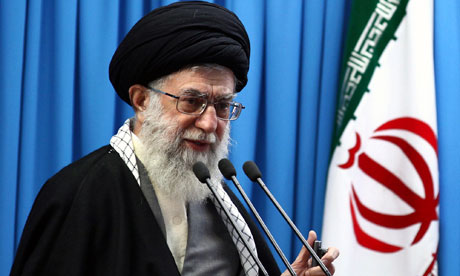
Story line 4 - Over the past several years, Iranian President Ahmadinejad could not deliver more bellicose and inflammatory statements than those he repeatedly spews, "there was no holocaust," "Israel will be wiped from the face of the earth, God willing," etc. From the UK Guardian, we also read that in the past few days, Iran's Ayatollah Ali Khamenei threatened to attack Israel in retaliation for western sanctions, and in a two-hour televised speech, he said: "From now on, in any place, if any nation or any group confronts the Zionist regime, we will endorse and we will help." He referred to Israel as a "cancerous tumour that should be cut and will be cut."
Iran's Supreme Leader, the Ayatollah Ali Khamenei matches the rhetoric of his President, calling Israel a "cancerous tumour that should be cut and will be cut."
Hossein Salami, the deputy head of Iran's elite Revolutionary Guards, told the semi-official Fars news agency. "Any spot used by the enemy for hostile operations against Iran will be subjected to retaliatory aggression by our armed forces ..."
So there we have it, on Superbowl Sunday, 2012, in the US. A sobering swirl of rhetoric and trajectories are once again building in the Middle East.
Not mentioned in this post is the distinction between leadership and the common person. In Israel, a wide variety of viewpoints and emotions are evident, though a threat to the very existence of the country gives everyone pause. In Iran, we in the West are only dimly aware of the resolve of much of the nation's youth and dissenters who had called for a Green Revolution in 2009; a serious and courageous act of defiance that received only very timid words of support from the West. Iran's leaders, in contrast, are harsh and inflexible ideologues judging by the vast majority of actions and speeches in the past 30 years.
So it seems as always, the fate of the common people in so many countries will be impacted by the egos, calculations (and miscalculations) of their leaders. Returning to the first sentences in this blog, will Western leaders of various nation's and institutions be able to prevail on Israel's leadership to postpone an attack in order to give more time to diplomacy and sanctions. Or is this more hand-wringing that places the hardest question back in the hands of the Israeli's.
US Defense Secretary Leon Panetta's strangely fatalistic observation that Israel is likely to strike Iran in the coming months, caught world attention. One assumes it was a deliberately chosen statement, designed to send messages to other world leaders, or distance the US from any Israeli action - one doesn't know.
This is indeed a time to pray for those numerous world leaders facing a narrowing time-frame for diplomatic progress.
1) Israel and Iran - an upcoming moment of truth
2) US President George W. Bush's "axis of evil" comment
3) Former French Foreign Minister Bernard Kouchner's comment to the effect that if the West does not take the issue of Iran's nuclear ambitions seriously, the default trajectory inevitably heads towards war.
4) Can one imagine a series of statements by the Iranian leadership more inflammatory than those offered?
The story of course, is that, according to one AP article today, "for the first time in nearly two decades of escalating tensions over Iran's nuclear program, world leaders are genuinely concerned that an Israeli military attack on the Islamic Republic could be imminent — an action that many fear might trigger a wider war, terrorism and global economic havoc.
Israel with a population of 7.6 million on a landbase of just under 8,000 square miles, and Iran with a population of nearly 78 million, on 636,000 square miles.
High-level foreign dignitaries, including the U.N. chief and the head of the American military, have stopped in Israel in recent weeks, urging leaders to give the diplomatic process more time to work. But U.S. Defense Secretary Leon Panetta has reportedly concluded that an Israeli attack on Iran is likely in the coming months.
Despite harsh economic sanctions and international pressure, Iran is refusing to abandon its nuclear program, which it insists is purely civilian, and threatening Israel and the West. It's beginning to cause jitters in world capitals and financial markets."
Story line 1 - Israel, after fighting at least four major wars with its Arab neighbors, and having been "born" out of the holocaust aftermath, has no illusions about security coming from any other nation's assurances than its own military abilities. Israel, through a string of national Prime Ministers from a spectrum of conservative to liberal ideologies, has never hesitated to unilaterally strike at direct threats. In June, 1981 Israeli warplanes struck Iraq's Osirak nuclear facility near Baghdad. In September, 2007, Israel bombed a suspected nuclear reactor in Syria. This time, the stakes are higher. Iran has long pursued nuclear capability, purportedly for civilian power, but the consensus is that a nuclear weapons component is drawing close. The challenge for Israel's capable air force is that the distance to Iran is much further than other actions, Iran's defense capabilities more daunting, or at least prepared, and that the scattered nature of the facilities make a comprehensive strike a larger and more complicated action.
Israeli fighter jets may be called upon for a world jolting action
Story line 2 - US President George W Bush famously called three countries (Iraq, Iran, and North Korea) an "axis of evil" soon after the Al Qaeda September 11, 2001 attack. While politically discredited in 2003 after being unable to locate weapons of mass destruction in the by-then occupied Iraq, his characterization remains. And two of the wild cards on the international stage are indeed, North Korea (with the capability of inflicting major damage regionally on South Korea or Japan), and Iran (with its belligerent stance in the oil rich Middle East, supporting known terrorist groups such as Hezbollah, Hamas, as well as Syria's odious Bashir Assad). As one commentator once observed, "some things are true, even if George Bush believes them ..."
Click on image for full picture
Iranian President Mahmoud Ahmadinejad stands next to the Iranian-made new-generation long-range cruise missile during the national Defense Industry Day ceremony in Tehran in August 2011.
Story line 3 - The respected Bernard Kouchner, founder of Doctors without Borders, and a recent foreign minister for France, once lamented the lack of serious and unified effort to prevent Iran from gaining nuclear weapons. He stated that if the West would not do everything within its power to prevent this development, then the trajectory would end up at what precisely everyone was hoping to avoid.
At this point, it should be noted that a straightforward Israeli strike against Iran's nuclear facilities could very likely spread in economic terms to a major world crisis. Iran has repeated thundered that if attacked, it would close the Straits of Hormuz to the ongoing flow of oil to the world's nations.. And every country would be confronted with the practicalities of whose side would they take, and in what form.
The prospects for an immediately wider conflict with world economic implications after an Israeli airstrike stems from the amount of oil flowing through the narrow straits of Hormuz
* Saudi Arabia - enemy of Israel, rival to Iran. Would it actively resist an overflight of Israeli jets on the way to bomb Iran? Would it actively resist a retaliatory response from Iran back at Israel?
* Germany - what practical measures of support would it provide to Israel under attack.
* Egypt, Turkey, Iraq - sit on the sidelines?
* The US, France, UK - regardless of position's taken to defend Israel, what steps would be needed to keep oil flowing from the region.
An Israeli strike would be a long distance one, and cross airspace of a number of hostile countries
Click on image for full pictureThe numerous nuclear facilities in Iran would mean a complicated and large Israeli strike.
An immediate defense of the oil flowing from the Persian Gulf would fall into the lap of the US Navy.
Story line 4 - Over the past several years, Iranian President Ahmadinejad could not deliver more bellicose and inflammatory statements than those he repeatedly spews, "there was no holocaust," "Israel will be wiped from the face of the earth, God willing," etc. From the UK Guardian, we also read that in the past few days, Iran's Ayatollah Ali Khamenei threatened to attack Israel in retaliation for western sanctions, and in a two-hour televised speech, he said: "From now on, in any place, if any nation or any group confronts the Zionist regime, we will endorse and we will help." He referred to Israel as a "cancerous tumour that should be cut and will be cut."
Iran's Supreme Leader, the Ayatollah Ali Khamenei matches the rhetoric of his President, calling Israel a "cancerous tumour that should be cut and will be cut."
Hossein Salami, the deputy head of Iran's elite Revolutionary Guards, told the semi-official Fars news agency. "Any spot used by the enemy for hostile operations against Iran will be subjected to retaliatory aggression by our armed forces ..."
So there we have it, on Superbowl Sunday, 2012, in the US. A sobering swirl of rhetoric and trajectories are once again building in the Middle East.
Not mentioned in this post is the distinction between leadership and the common person. In Israel, a wide variety of viewpoints and emotions are evident, though a threat to the very existence of the country gives everyone pause. In Iran, we in the West are only dimly aware of the resolve of much of the nation's youth and dissenters who had called for a Green Revolution in 2009; a serious and courageous act of defiance that received only very timid words of support from the West. Iran's leaders, in contrast, are harsh and inflexible ideologues judging by the vast majority of actions and speeches in the past 30 years.
So it seems as always, the fate of the common people in so many countries will be impacted by the egos, calculations (and miscalculations) of their leaders. Returning to the first sentences in this blog, will Western leaders of various nation's and institutions be able to prevail on Israel's leadership to postpone an attack in order to give more time to diplomacy and sanctions. Or is this more hand-wringing that places the hardest question back in the hands of the Israeli's.
US Defense Secretary Leon Panetta's strangely fatalistic observation that Israel is likely to strike Iran in the coming months, caught world attention. One assumes it was a deliberately chosen statement, designed to send messages to other world leaders, or distance the US from any Israeli action - one doesn't know.
This is indeed a time to pray for those numerous world leaders facing a narrowing time-frame for diplomatic progress.
Sunday, January 29, 2012
From Nigeria to Egypt to Somalia ...
Nigeria, Libya, South Sudan, Egypt, Kenya, Ethiopia, Somalia - each of these countries across North Africa made the news this past week for a variety of reasons.
Click on image for full picture
Nigeria - The onslaught of the Boko Haram in northern Nigeria escalated this week with the group’s deadliest ever strike on Jan. 20 in Nigeria’s second largest city of Kano. There, a coordinated set of gun and bomb attacks killed at least 185 people. Heavily criticized amid the escalating violence, Nigerian President Goodluck Jonathan urged the Boko Haram to enter dialogue, challenging the violent Islamist sect to identify themselves and state clearly their demands as a basis for talks, while acknowledging that military confrontation alone will not end their insurgency. At the presidential villa in the capital Abuja, President Jonathan said, “If they clearly identify themselves now and say this is the reason why we are resisting, this is the reason why we are confronting government or this is the reason why we destroy some innocent people and their properties ... then there will be a basis for dialogue.”
Click on image for full picture
Nigeria with the city of Kano as the site of the latest violence, and the district of Sokoto to the northwest now under threat. In the farther northeast, the town of Maiduguri is considered a stronghold of Boko Haram.
In another report, Boko Haram spokesman Abul Qaqa told journalists Sunday by telephone in the northeastern city of Maiduguri that Jonathan’s call for talks was “not sincere.” Moreover, the spokesman declared that if captured members of the group were not released, it “will launch attacks in Sokoto (another Northern Nigerian city) similar to the big Kano attacks.”
And from Reuters, "Islamist sect Boko Haram, whose attacks have killed hundreds in Nigeria, will continue its campaign until the country is ruled by sharia law, a senior member was quoted as saying by British newspaper, The Guardian. The same Abu Qaga told the Guardian, "We will consider negotiation only when we have brought the government to their knees, ... Once we see that things are being done according to the dictates of Allah, and our members are released (from prison), we will only put aside our arms - but we will not lay them down. You don't put down your arms in Islam, you only put them aside."
Boko Haram fighters. From a Cameroonian blogsite, a breakdown of boko haram is instructive: “The ideology and philosophy of the movement can best be understood by explicating the two words- “Boko” and “Haram”. In Hausa language, the word “boko” is an equivocal term which means either “Western” or foreign; while the word “haram” is an Arabic derivative meaning “forbidden”. Piecing the two words together, ‘boko haram’ means to forbid everything Western and Western education. The intent is to replace modern state formation with the traditional Islamic state, because Western values run contrary to Islamic values. (Teatree - it is a strange bit of logic that Western values are to be rejected while Western armaments are embraced)
Libya From Nigeria northeast to Libya, the hopes that the ouster of Gaddafi would lead to a clear improvement in governance was dealt a blow when Gaddafi loyalists retook Bani Walid. According to a Christian Science Monitor article, hundreds of well-equipped and highly trained remnants of Qaddafi forces raised the green flag over buildings in the western city late Monday after hours of clashes, said Mubarak al-Fatamni, the head of Bani Walid local council.
Click on image for full picture Bani Walid once again under Gaddafi loyalist control
The retaking of this former Gaddafi stronghold comes as Libya's new leaders struggle to unify the oil-rich North African nation three months after the former dictator was captured and killed. There are new reports of torture in various prisons around the country, themselves held by a variety of militia's more or less acting on their own.
Bani Walid showing the scars of the recent fight, with apparently more to come.
South Sudan Moving Southeast from Libya, the world's newest country, South Sudan, is facing enormous difficulties. Once of the latest issues is a dispute with the Republic of Sudan over the transport fees in sending its oil north through pipelines for export. With the Republic of Sudan making demands that South Sudan considers unacceptable, it is mulling cutting off oil supplies altogether as a way to raise the stakes.
Ripe for disagreement or mutual benefit: Oil, transit, South Sudan, and the Republic of Sudan
The South Sudanese government has apparently decided to shut down oil flow north, in hopes of pressuring the Republic of Sudan to give better terms for the use of the pipelines.
The Republic of Sudan, meanwhile, is facing its own crisis with Chinese oil workers kidnapped by internal rebels. (What was first reported as five, the number was raised to 29, and the latest is approximately 70.) The men were working Saturday when they were abducted in the southern Kordofan province, the epicenter of Sudan's oil industry and next to Darfur where ethnic African rebels are fighting the Arab-dominated government.
"We are doing our best efforts to find them," Chinese Ambassador to Sudan Li Chengwen told The Associated Press. There was no immediate claim of responsibility for the kidnapping and the circumstances of their capture remain unclear. The rebels, along with many international rights activists, accuse China of indirectly funding Khartoum's war effort in Darfur through massive investment in Sudan's oil industry.
Chinese oil workers in the Republic of Sudan
Egypt North from South Sudan to Egypt, the disquieting results of the "Arab Spring" came in the form of Islamists filling the first round of parliamentary positions. From the New York Times, Islamists,propelled largely by the Muslim Brotherhood, won the overwhelming majority of seats in Egypt's parliament, which held its first session Jan. 23 and is set to elect a 100-member panel to draft a new constitution. The "mainstream" Brotherhood won about 47 percent of the seats, and an alliance of ultraconservative Islamists known as the Salafis gained another 25 percent."
For most of its 84-year history, the Muslim Brotherhood, Egypt's largest and most organized political group, had been banned from political participation, but that changed last spring with the revolt that led to the overthrow of President Hosni Mubarak.
The young leaders who began the revolt won only a few percent of the seats in parliament.
Protests over Egypt's interim army rulers continue, and no one really knows what the future holds for an eventual new government - Islamic rule clashing with secular and modern values seems most likely.
Kenya South from Egypt to Kenya. A Christian Science Monitor article reports, "The International Criminal Court in The Hague has sent a signal that there are consequences for political leaders who use violence to achieve political goals by confirming charges of crimes against humanity against four prominent Kenyans. Whether this changes the political landscape, ends the culture of impunity, or prevents future violence in Kenya, is a matter for Kenyans themselves to decide."
The article continues, "In its decision, announced from the Hague today, the ICC confirmed charges of crimes against humanity first laid in Dec. 2010 against four men for their alleged role in organizing mass violence following the 2007 presidential elections. The charged are former Higher Education Minister William Ruto, former Finance Minister Uhuru Kenyatta, former civil service chief Francis Muthaura, and radio talk show host Joshua arap Sang. The four men are accused of organizing mass violence following the disputed presidential elections of 2007, in which President Mwai Kibaki was declared the winner. Senior leaders of both main parties, the president’s Party of National Unity and the opposition Orange Democratic Movement, are accused of stirring up ethnic violence for political advantage and retribution. At least 1,200 people were killed and 600,000 displaced from their homes.
Two of the accused, Mr. Ruto and Mr. Kenyatta, have declared their intentions to run for president in the 2013 elections, and the newly written Kenyan constitution is ambiguous on whether those facing criminal charges can run for public office. “The constitution does not forbid a person from running for office who is faced with criminal charges,” said Comfort Ero, who heads an International Crisis Group based in Nairobi. But the constitution does say that a president who faces criminal charges is vulnerable to impeachment, and in that spirit, Ruto and Kenyatta could possibly be tossed out of office with a two-thirds vote of parliament. The question is more a political and moral one than it is a legal one,” she adds. “How will Kenyans react to this decision? How will they feel about a candidate, knowing that he faces such charges? Is this the sort of person they want to have in office?”
A combination photograph shows Kenya's finance minister Uhuru Kenyatta (L) addressing a news conference in his office in the capital Nairobi in a file photo, and former Kenyan cabinet minister William Ruto, both running for the Kenyan presidency.
South Sudan, Republic of Sudan, Ethiopia, Kenya, and Somalia
Ethiopia. Back north to Ethiopia. Here, the Africa Union is meeting in a brand new headquarters. It was built as a gift by China - illustrating the ties China is building in various African nations.
Not bad, hopefully the new building will house strong, ethical institutions and allow similar decision making in Africa to grow.
Somalia The last of the brief country highlights. A US special forces raid freed two aid workers unharmed who had been held for nearly three months. Jessica Buchanan, 32, and Poul Hagen Thisted, 60 were abducted on Oct. 25 in Galkayo, while visiting a de-mining project there, according to their employer, the Copenhagen-based Danish Refugee Council.
Somalia, splintered now for decades, has Kenyan troops pushing from the southwest, and Africa Union forces supporting a weak central government, against the main Islamist group, Al Shaabab, in control of most everywhere else. Famine and lack of security go hand in hand in this stricken land.
So this long blog post covers thousands of miles and a reminder of how big and varied is just the north half of the African continent.
Click on image for full picture
Nigeria - The onslaught of the Boko Haram in northern Nigeria escalated this week with the group’s deadliest ever strike on Jan. 20 in Nigeria’s second largest city of Kano. There, a coordinated set of gun and bomb attacks killed at least 185 people. Heavily criticized amid the escalating violence, Nigerian President Goodluck Jonathan urged the Boko Haram to enter dialogue, challenging the violent Islamist sect to identify themselves and state clearly their demands as a basis for talks, while acknowledging that military confrontation alone will not end their insurgency. At the presidential villa in the capital Abuja, President Jonathan said, “If they clearly identify themselves now and say this is the reason why we are resisting, this is the reason why we are confronting government or this is the reason why we destroy some innocent people and their properties ... then there will be a basis for dialogue.”
Click on image for full picture
Nigeria with the city of Kano as the site of the latest violence, and the district of Sokoto to the northwest now under threat. In the farther northeast, the town of Maiduguri is considered a stronghold of Boko Haram.
In another report, Boko Haram spokesman Abul Qaqa told journalists Sunday by telephone in the northeastern city of Maiduguri that Jonathan’s call for talks was “not sincere.” Moreover, the spokesman declared that if captured members of the group were not released, it “will launch attacks in Sokoto (another Northern Nigerian city) similar to the big Kano attacks.”
And from Reuters, "Islamist sect Boko Haram, whose attacks have killed hundreds in Nigeria, will continue its campaign until the country is ruled by sharia law, a senior member was quoted as saying by British newspaper, The Guardian. The same Abu Qaga told the Guardian, "We will consider negotiation only when we have brought the government to their knees, ... Once we see that things are being done according to the dictates of Allah, and our members are released (from prison), we will only put aside our arms - but we will not lay them down. You don't put down your arms in Islam, you only put them aside."
Boko Haram fighters. From a Cameroonian blogsite, a breakdown of boko haram is instructive: “The ideology and philosophy of the movement can best be understood by explicating the two words- “Boko” and “Haram”. In Hausa language, the word “boko” is an equivocal term which means either “Western” or foreign; while the word “haram” is an Arabic derivative meaning “forbidden”. Piecing the two words together, ‘boko haram’ means to forbid everything Western and Western education. The intent is to replace modern state formation with the traditional Islamic state, because Western values run contrary to Islamic values. (Teatree - it is a strange bit of logic that Western values are to be rejected while Western armaments are embraced)
Libya From Nigeria northeast to Libya, the hopes that the ouster of Gaddafi would lead to a clear improvement in governance was dealt a blow when Gaddafi loyalists retook Bani Walid. According to a Christian Science Monitor article, hundreds of well-equipped and highly trained remnants of Qaddafi forces raised the green flag over buildings in the western city late Monday after hours of clashes, said Mubarak al-Fatamni, the head of Bani Walid local council.
Click on image for full picture Bani Walid once again under Gaddafi loyalist control
The retaking of this former Gaddafi stronghold comes as Libya's new leaders struggle to unify the oil-rich North African nation three months after the former dictator was captured and killed. There are new reports of torture in various prisons around the country, themselves held by a variety of militia's more or less acting on their own.
Bani Walid showing the scars of the recent fight, with apparently more to come.
South Sudan Moving Southeast from Libya, the world's newest country, South Sudan, is facing enormous difficulties. Once of the latest issues is a dispute with the Republic of Sudan over the transport fees in sending its oil north through pipelines for export. With the Republic of Sudan making demands that South Sudan considers unacceptable, it is mulling cutting off oil supplies altogether as a way to raise the stakes.
Ripe for disagreement or mutual benefit: Oil, transit, South Sudan, and the Republic of Sudan
The South Sudanese government has apparently decided to shut down oil flow north, in hopes of pressuring the Republic of Sudan to give better terms for the use of the pipelines.
The Republic of Sudan, meanwhile, is facing its own crisis with Chinese oil workers kidnapped by internal rebels. (What was first reported as five, the number was raised to 29, and the latest is approximately 70.) The men were working Saturday when they were abducted in the southern Kordofan province, the epicenter of Sudan's oil industry and next to Darfur where ethnic African rebels are fighting the Arab-dominated government.
"We are doing our best efforts to find them," Chinese Ambassador to Sudan Li Chengwen told The Associated Press. There was no immediate claim of responsibility for the kidnapping and the circumstances of their capture remain unclear. The rebels, along with many international rights activists, accuse China of indirectly funding Khartoum's war effort in Darfur through massive investment in Sudan's oil industry.
Chinese oil workers in the Republic of Sudan
Egypt North from South Sudan to Egypt, the disquieting results of the "Arab Spring" came in the form of Islamists filling the first round of parliamentary positions. From the New York Times, Islamists,propelled largely by the Muslim Brotherhood, won the overwhelming majority of seats in Egypt's parliament, which held its first session Jan. 23 and is set to elect a 100-member panel to draft a new constitution. The "mainstream" Brotherhood won about 47 percent of the seats, and an alliance of ultraconservative Islamists known as the Salafis gained another 25 percent."
For most of its 84-year history, the Muslim Brotherhood, Egypt's largest and most organized political group, had been banned from political participation, but that changed last spring with the revolt that led to the overthrow of President Hosni Mubarak.
The young leaders who began the revolt won only a few percent of the seats in parliament.
Protests over Egypt's interim army rulers continue, and no one really knows what the future holds for an eventual new government - Islamic rule clashing with secular and modern values seems most likely.
Kenya South from Egypt to Kenya. A Christian Science Monitor article reports, "The International Criminal Court in The Hague has sent a signal that there are consequences for political leaders who use violence to achieve political goals by confirming charges of crimes against humanity against four prominent Kenyans. Whether this changes the political landscape, ends the culture of impunity, or prevents future violence in Kenya, is a matter for Kenyans themselves to decide."
The article continues, "In its decision, announced from the Hague today, the ICC confirmed charges of crimes against humanity first laid in Dec. 2010 against four men for their alleged role in organizing mass violence following the 2007 presidential elections. The charged are former Higher Education Minister William Ruto, former Finance Minister Uhuru Kenyatta, former civil service chief Francis Muthaura, and radio talk show host Joshua arap Sang. The four men are accused of organizing mass violence following the disputed presidential elections of 2007, in which President Mwai Kibaki was declared the winner. Senior leaders of both main parties, the president’s Party of National Unity and the opposition Orange Democratic Movement, are accused of stirring up ethnic violence for political advantage and retribution. At least 1,200 people were killed and 600,000 displaced from their homes.
Two of the accused, Mr. Ruto and Mr. Kenyatta, have declared their intentions to run for president in the 2013 elections, and the newly written Kenyan constitution is ambiguous on whether those facing criminal charges can run for public office. “The constitution does not forbid a person from running for office who is faced with criminal charges,” said Comfort Ero, who heads an International Crisis Group based in Nairobi. But the constitution does say that a president who faces criminal charges is vulnerable to impeachment, and in that spirit, Ruto and Kenyatta could possibly be tossed out of office with a two-thirds vote of parliament. The question is more a political and moral one than it is a legal one,” she adds. “How will Kenyans react to this decision? How will they feel about a candidate, knowing that he faces such charges? Is this the sort of person they want to have in office?”
A combination photograph shows Kenya's finance minister Uhuru Kenyatta (L) addressing a news conference in his office in the capital Nairobi in a file photo, and former Kenyan cabinet minister William Ruto, both running for the Kenyan presidency.
South Sudan, Republic of Sudan, Ethiopia, Kenya, and Somalia
Ethiopia. Back north to Ethiopia. Here, the Africa Union is meeting in a brand new headquarters. It was built as a gift by China - illustrating the ties China is building in various African nations.
Not bad, hopefully the new building will house strong, ethical institutions and allow similar decision making in Africa to grow.
Somalia The last of the brief country highlights. A US special forces raid freed two aid workers unharmed who had been held for nearly three months. Jessica Buchanan, 32, and Poul Hagen Thisted, 60 were abducted on Oct. 25 in Galkayo, while visiting a de-mining project there, according to their employer, the Copenhagen-based Danish Refugee Council.
Somalia, splintered now for decades, has Kenyan troops pushing from the southwest, and Africa Union forces supporting a weak central government, against the main Islamist group, Al Shaabab, in control of most everywhere else. Famine and lack of security go hand in hand in this stricken land.
So this long blog post covers thousands of miles and a reminder of how big and varied is just the north half of the African continent.
Wednesday, January 25, 2012
Scottish Independence?
Even the referendum vote on the simple question, “Do you agree that Scotland should be an independent country?” is not to be on a ballot until the fall of 2014, but the newsworthiness is.
The United Kingdom (UK) is comprised of Northern Ireland, Scotland, England, and Wales. Scotland's population is around 5.2 million, less than 10 percent to that of the rest of the UK population of 57 million .
From a Bloomberg Business article, we find out that Scottish First Minister Alex Salmond put forward a consultation document for the vote in the Scottish Parliament in Edinburgh on January 25. “The next 2-1/2 years promise to be the most exciting in Scotland’s modern history,” Salmond, leader of the Scottish National Party, said on the day Scots commemorate the birth of national poet Robert Burns. “The people who live, work and bring up families in Scotland should make the decision on its future. Our success should be in our own hands.”
Edinborough, the Scottish capitol city
The First Minister fired the starting gun on the debate over might be the break-up of the U.K. The Scottish National Part, which won an unprecedented majority in the semi-autonomous Edinburgh legislature last year, seeks to maximize revenue from North Sea oil and minimize how much debt Scotland must assume. The opposition parties in the Scottish Parliament, including U.K. Prime Minister David Cameron’s Conservatives, oppose independence.
North Sea oil has brought immense wealth to the UK and Norway, but the actual production is beginning to decline
In truth, we are a long way from witnessing Scottish Independence. While opinion polls show increasing support in Scotland for independence, only a minority in the country has declared an intention to vote for it. Others say that the referendum on independence is more likely a way to further actual governing power in Scotland. Supporters of more devolution (power transferred to local structures rather than centralized), including former Scottish First Minister Henry McLeish, say it involves giving Scotland full fiscal autonomy, leaving the U.K. government responsible for foreign affairs and defense.
A modern building housing the Scottish Parliament
The Scottish parliament, re-established in 1999 after three centuries, has power over issues such as health, education and the legal system. The budget in Edinburgh is currently based on a grant from the U.K. government in London, totaling about 28 billion pounds ($43.6 billion) this year. Based on current figures, Scotland would have the sixth-highest gross domestic product per capita in the Organization for Economic Cooperation and Development, Salmond said today. The Scottish government is also looking at extending the vote to 16 and 17-year-olds, he said, as another way to increase the Scottish sense of self governance.
Scottish First Minister Alex Salmond conversing with his Queen.
Fascinating ...
One of many breathtaking Scottish castle ruins
Lots of Scottish redheads ...
The United Kingdom (UK) is comprised of Northern Ireland, Scotland, England, and Wales. Scotland's population is around 5.2 million, less than 10 percent to that of the rest of the UK population of 57 million .
From a Bloomberg Business article, we find out that Scottish First Minister Alex Salmond put forward a consultation document for the vote in the Scottish Parliament in Edinburgh on January 25. “The next 2-1/2 years promise to be the most exciting in Scotland’s modern history,” Salmond, leader of the Scottish National Party, said on the day Scots commemorate the birth of national poet Robert Burns. “The people who live, work and bring up families in Scotland should make the decision on its future. Our success should be in our own hands.”
Edinborough, the Scottish capitol city
The First Minister fired the starting gun on the debate over might be the break-up of the U.K. The Scottish National Part, which won an unprecedented majority in the semi-autonomous Edinburgh legislature last year, seeks to maximize revenue from North Sea oil and minimize how much debt Scotland must assume. The opposition parties in the Scottish Parliament, including U.K. Prime Minister David Cameron’s Conservatives, oppose independence.
North Sea oil has brought immense wealth to the UK and Norway, but the actual production is beginning to decline
In truth, we are a long way from witnessing Scottish Independence. While opinion polls show increasing support in Scotland for independence, only a minority in the country has declared an intention to vote for it. Others say that the referendum on independence is more likely a way to further actual governing power in Scotland. Supporters of more devolution (power transferred to local structures rather than centralized), including former Scottish First Minister Henry McLeish, say it involves giving Scotland full fiscal autonomy, leaving the U.K. government responsible for foreign affairs and defense.
A modern building housing the Scottish Parliament
The Scottish parliament, re-established in 1999 after three centuries, has power over issues such as health, education and the legal system. The budget in Edinburgh is currently based on a grant from the U.K. government in London, totaling about 28 billion pounds ($43.6 billion) this year. Based on current figures, Scotland would have the sixth-highest gross domestic product per capita in the Organization for Economic Cooperation and Development, Salmond said today. The Scottish government is also looking at extending the vote to 16 and 17-year-olds, he said, as another way to increase the Scottish sense of self governance.
Scottish First Minister Alex Salmond conversing with his Queen.
Fascinating ...
One of many breathtaking Scottish castle ruins
Lots of Scottish redheads ...
Subscribe to:
Posts (Atom)