North Korea

North Korea
The always bombastic and unpredictable North Koreans go hysterical again. This time the country is prepared to "go to war" with South Korea because that country is playing loudspeakers directed at North Korean territory. A headline from a UK paper reads, "More than 50 North Korea submarines 'leave their bases' as war talks with South continue "

Saturday, August 30, 2014

Now it's the UAE ...

We'll make it quick - another post on the spreading conflicts across the Arab world. This time one of the small conservative monarchies that usually receives little attention, the United Arab Emirates, is involved.

Where is the UAE?

Answer, it is in a rather delicate location, ie. a key location, making up the peninsula of land that separates the Persian Gulf from the Indian Ocean. Which means the UAE sits with a bird's eye view of over 35% of the world's sea-borne oil traffic (in a rather unstable region to say the least).

The UAE, like a thorn poised to puncture a balloon loaded with oil ... Though if one looks closely at the map, the actual point of the thorn is an exclave of Oman. Graphic from wikipedia.

Iran, all the land to the right in this photo, has long declared its intentions to sink a few of those oil tankers traveling through the narrow Strait of Hormuz, if it felt threatened. Photo from www.infowars.com

Oil tankers threading through a number of military vessels. Teatree isn't sure if this congestion is normal, or from one of many tension-filled spats in the recent past. Photo from www.newsbomb.gr

Wikipedia states "UAE's total population was 9.2 million; 1.4 million Emirati citizens and 7.8 million expatriates." Somewhere close to the truth, though estimates range from 3.8 million native Arabic speaking citizens and the balance are foreign workers. The point is that there are substantially more non-native dwellers - a situation that is alleviated by the fact that citizens and residents alike in the small set of emirates enjoy a wealthy income average.

Established in late 1971, the country is a federation of seven emirates (equivalent to principalities). Each emirate is governed by a hereditary emir who jointly form the Federal Supreme Council, the highest legislative and executive body in the country. One of the emirs is selected as the President of the United Arab Emirates. The constituent emirates are Abu Dhabi, Ajman, Dubai, Fujairah, Ras al-Khaimah, Sharjah, and Umm al-Quwain. The capital is Abu Dhabi, which is one of the two centers of commercial and cultural activities, together with Dubai.

Abu Dhabi and Dubai are the UAE's two major cities - it is rather hard to believe the wealth and commercial buildings that have been built up in this small country. Photo from www.sohbetna.com

Where are a lot of those workers from? Again from Wikipedia, "UAE and India are each other's main trading partners, with the latter having many of its citizens working and living in the former."

Actually an interesting picture that shows ethnic UAE arabs and many Indian office workers. They were evacuating the breathtaking high towers, after some earthquake tremors in 2013. Photo from www.daijiworld.com

What's UAE been up to?

Soberingly enough, last week the UAE, in partnership with Egypt who provided support from its western air bases, sent fighter jets to the North African coast, to bomb Islamist positions surrounding Libya's main airport in Tripoli. Egypt and the UAE, and one supposes other Arab nations are acting on their own to support a faction in Libya more to their liking than Islamist militias.

A UAE F-16 fighter jet in an unrelated photo, but likely the model used in action in Libya. Photo from Canada's National Post

Libya, of course, was the showcase three years ago for Western powers on how to depose a ruthless dictator Colonel Ghadaffi and usher in an Arab version of democracy all with relatively risk free cruise missiles and bombers. An all-important endorsement at the time of the Arab League for brief, limited intervention was deemed and trumpeted as essential, and expectations were that Libya could steadily move forward with representative elections. However, as the US and Western allies' narratives of smart diplomacy and international coalitions as the correct approach began to diverge while the continued conflicts and fighting between militias escalated, a vacuum of leadership and power emerged and deepened, complete with dueling parliaments. Now,the UAE and Egypt have opted to go it alone in support of their own interests in Egypt's neighbor, not even bothering to communicate with the Western nations ahead of time.

A very cleaned up map of Libya, that nonetheless hints at some of the ancient ethnic lines running through this artificially constructed nation-state. Graphic from www.telegraph.co.uk

Smoke rises from the area near Libya's main airport in Tripoli after UAE airstrikes in support of a Libyan General's forces fighting Islamist militias. (However, in spite of the airstrikes, Islamists - under the banner of "Dawn of Libya" - still took control of the airport) For an illuminating article, read this by The Guardian newspaper last week.

A fair number of airplanes now sit on Tripoli airport tarmac, damaged by fighting. Photo from Reuters

That's it. Libya is splintering, many sides are available to be backed, the UAE has felt compelled to participate, and Western powers are sidelined across the region, as the Arab world unravels.

Sunday, August 17, 2014

ISIS, boundaries, and porous borders

A long time ago in a galaxy far far away, the Middle East was a place of calm and brotherly-love. All the boundaries between nations accurately reflected ethnic concentrations and had done so since ages past (except for the arbitrary borders of a vast region on the Mediterranean sea occupied by the warlike Zionist entity).

Peaceful and wise governance could be found everywhere – Saddam Hussein did not gas his own people in the village of Halabja in 1988, he did not invade and terrorize Kuwait in 1991, he did not slaughter over 100,000 Shiites in the aftermath of that war that didn't happen, he was not a major funding source for the families of brave Palestinian suicide martyrs fighting against the lone evil in the region – aggressive, oppressive Israel - and finally he did not send rockets into said Israel during the 1991 war that did not happen.

But in 2003, US forces at the order of President George W Bush and his Vice President Cheney, invaded and occupied the long-time secure and sensible boundaries of Iraq where Kurds, Sunnis and Shias lived in geographically connected harmonious bliss, ruled by what might be conceded the firm but fatherly hand of Saddam Hussein. And since that single unprecedented day, and those dreadful years following till 2009 when Bush left office, that peaceful land has not been able to recover, nor any of the nations of the Arab world. Indeed, across all the Arab lands, little divisions have sprung up and coalesced, through no fault of any, into extremist factions of various kinds, where not one existed before (except those groups of would-be martyrs who were only seeking to right the wrongs perpetrated by Israeli occupation of the sacred-since-ages-past, inviolate land of Palestine).

And thus IS (ISIS, ISIL), the most evil result of them all, has surfaced – the consummate end product of the Bush-Cheney imperialist adventure.


The new Islamic State's caliphate - sacred national Arab boundaries be damned. Graphic from jackspotpourri.blogspot.com

The atrocities of IS speak volumes and are clear enough for anyone who wants to take note. Massacres, crucifixions, torture, rape, beheadings, kidnappings of women for wedding prizes - all are amply reported on, though somewhat jarring to reconcile with Abu Bakr al-Baghdadi (now calling himself “Caliph Ibrahim”) invitation to Muslims to migrate to his land. Though the kindly call for doctors and engineers to build the caliphate has been extended, as noted in an article by the UK Daily Mail, "not a single Muslim country has seen a mass exodus of people keen to live under his version of sharia."


The latest Islamic psychopath, Abu Bakr al-Baghdadi (aka "Caliph Ibrahim”) apparently likes his Rolex ... Photo from news.nationalpost.com

National Arabic boundaries

If nothing else, the IS caliphate shows the myth of secure and ethnically sensible boundaries in the Arab world. This group doesn't care, and it scorns the placement of borders by European powers nearly 100 years previous. Yet the larger story is that everywhere in the world, borders have been placed arbitrarily, the result of conflicts or negotiation, or some combination thereof, and has little to do with how the modern governments of any region decide to work with neighbors - friendly or hostile.

Regarding the Middle East, one can start with the Ottoman Empire that was essentially broken up at the end of World War I. The first two maps below show the Middle East in rapid change from 1914 to 1940, while the third map highlights the one and only set of borders (of Israel) that is intolerable to all the other entities whose borders were arbitrarily drawn at the same time ...


The Arab world - before World War I. Graphic from lostislamichistory.com (which is also a very worthwhile website)


The Arab world - before World War II. Graphic from lostislamichistory.com


Yes, that thorn in the Arab side has just as long a history of existence as do virtually all the boundaries of its neighbors. Graphic from forthegrandchildren.blogspot.com


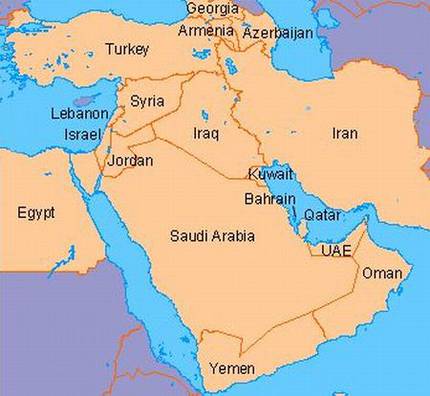
National boundaries today. Graphic from www.hotelsinthemiddleeast.com

So the boundaries of the Middle East nations are suddenly being exposed as fragile and arbitrary as they are - the real challenge is governance. Have the Kurds, based on their relatively sound governance in the midst of a broken Iraq, suddenly found an opening to assert their own entity?

Just for fun, here's how a map of the Middle East might look if it were more representative of major ethnic groupings. Click on the image to see a larger, more readable version.


Ralph Peters, a former United States Army Lieutenant Colonel drew a map in 2006, which created quite an outcry at the time. But note, according to a post at www.geographictravels.com "how the proposal for Syria mirrors what is going on now with the Kurds going their own way and the coastal area becoming an Alawite enclave aligned with Hizbollah in Lebanon." Graphic from www.geographictravels.com

Porous borders

We've talked at length in various posts about refugees and internally displaced peoples around the world and in trouble spots. But the borders Teatree speaks of is in regard to the many young ISIS jihadists from across Europe who have gone to the Middle East, gaining expertise in killings and mayhem, and who also have passports to return home. While ISIS currently terrorizes the lands of Syria and Iraq (both likely to disintegrate), the concern of Western and indeed other Muslim nations' intelligence agencies is how to track hundreds of fighters who hold the option of returning to their own lands over the next few years.

British Islamists protest outside the French Embassy in London January 12, 2013. Reuters. Photo from rt.com


Possible returnees by the numbers. Graphic from USNews.com


In the UK, according to an article in www.jihadwatch.org, "Communities have been bombarded with the posters, which read: “˜You are entering a Sharia-controlled zone ““ Islamic rules enforced.” The bright yellow messages daubed on bus stops and street lamps have already been seen across certain boroughs in London and order that in the “˜zone” there should be “˜no gambling”, “˜no music or concerts”, “˜no porn or prostitution”, “˜no drugs or smoking” and “˜no alcohol”." Photo from www.jihadwatch.org

The cauldron continues to roil, the heat is still rising.

Sunday, August 10, 2014

The mystifying support of Hamas

As the world's media once again is consumed with IS (the Islamic State in Northern Iraq and Eastern Syria), perhaps a moment might be spent on the month-long flareup between Hamas and Israel. Not that there hasn't been a world-wide, though brief, focus on this deadly relationship already.

Israel- with a dense population of 8 million contained within an 8 thousand square mile territory. Its story is pretty well known: embattled from the start, Zionists in the early 20th century coming back to what was then a pastoralist backwater, then erupting as a place of refuge stemming from the holocaust of WWII. Neighboring Arab nations, themselves with borders drawn artificially (see present day conflicts) incensed that a Jewish state could be shoehorned in as well, fight the UN approved establishment of a new nation, fight to annihilate the state in 1948, 1956, 1967, 1973 and 1982 wars. Still standing, most of the Arab world (oh, and Iran as well) still hysterically hostile to this nation with its western values of democracy and tolerance.

Click image for full picture
Israel, the eternal thorn in the Arab world. The current war cry is "occupation" of Palestinian lands, an "upgrade" from the genocidal "drive the Jews into the sea" used in the previous five conflicts. Graphic from www.discussionist.com

Hamas- controls and "governs" what is known as the Gaza strip, a very dense spit of land full of Palestinians sandwiched between Egypt and Israel. From Wikipedia, we read, "a Palestinian Sunni Islamic organization in the Palestinian territories and elsewhere in the Middle East including Qatar. Since 2007, it has governed the Gaza Strip, after it won a majority of seats in the Palestinian Parliament in the 2006 Palestinian parliamentary elections. ... Based on the principles of Islamism gaining momentum throughout the Arab world in the 1980s, Hamas was founded in 1987 as an offshoot of the Egyptian Muslim Brotherhood. Co-founder Sheik Ahmed Yassin stated in 1987, and the Hamas Charter affirmed in 1988, that Hamas was founded to liberate Palestine from Israeli occupation and to establish an Islamic state in the area that is now Israel, the West Bank and the Gaza Strip ..."

Click image for full picture
Hamas governs the Gaza strip with a population of 1.8 million, while Fatah governs the West Bank with a population of 1.7 million. Graphic from blogs.blouinnews.com

The repeating conflict.

The latest round of fighting between Hamas and Israel looks depressingly similar to previous flareups. Rocket attacks from the Gaza strip into Israel, and heavy Israeli retaliation - a scenario that has repeated itself practically every two years for the past 12 or so. As Wikimedia outlines it, "Attacks began in 2001. Since then, nearly 4,800 rockets have hit southern Israel, just over 4,000 of them since Israel withdrew from the Gaza Strip in August 2005. The range of the rockets has increased over time. Some analysts see the attacks as a shift away from reliance on suicide bombing, which was previously Hamas's main method of attacking Israel, and an adoption of the rocket tactics used by Lebanese militant group Hezbollah."

Click image for full picture
Israel maintains rocket fire from Gaza is often originating in residences, in or near mosques, or near hospitals. Photo from www.theblaze.com

The conflict begins - Teatree believes it fair to say that Hamas usually instigates it - with rocket attacks. Israel responds with the justification that no nation would put up with such attacks. Palestinian fatalities increase dramatically, the world blame begins to shift towards Israel for disproportionate response, and finally a cease fire is arranged. Israel is cast again as the violent and unjust bully, including Israel's imposition of an unjust blockade of legitimate supplies to the Palestinians of Gaza. Perversely, Hamas is considered the moral victor. And political posturing begins which inexorably leads to the next round of fighting. That has been the pattern.

Click image for full picture
It seems a long time ago, but 2008-2009 was a time when support for Gaza was at its highest, support for Israel perhaps the lowest, there was a new hope in the US, and the flotilla to break the Gaza blockade by Israel was a popular, Hollywood and international celebrity cause celebre ... Photo from www.presstv.ir

The current round

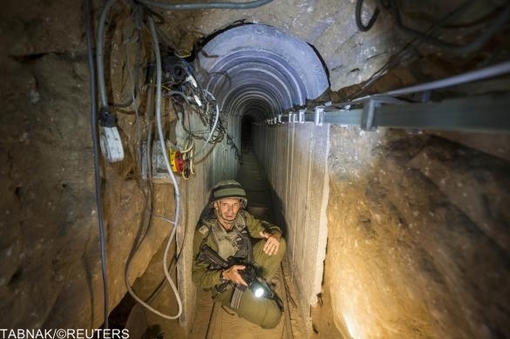
This 2014 chapter, which began with an additional emotional element as three Israeli teens were abducted and killed, and a Palestinian youth killed in revenge by Israeli extremists, had several new dynamics. Hamas has moved on from suicide bombing and rocket attacks, to rockets and tunneling into Israel. Israel stated its military goal was to destroy these tunnels. From a US Washington Times newspaper article, "Information that Israel Defense Forces reportedly obtained from captured Hamas fighters revealed that the group was planning to use several Gaza tunnels that extend under Israeli territory for a major attack timed with the beginning of the Jewish new year, Rosh Hashanah, on September 24. The plan called for Hamas fighters to surface from the tunnels in Israel and kill as many people as possible. The plot was first reported by the Israeli newspaper Maariv. Israel’s military operation against Hamas in Gaza has gone on longer than expected because of the discovery of the extensive tunnel network, which is estimated to have cost as much as $2 billion to construct."

One can argue the intent of Hamas regarding the use of, but not the existence of, sophisticated tunnels. Tunnels which, by the way, were complete with specialized holding rooms stockpiled with tranquilizers and restraints, one assumes, for the goal of securing captured Israeli soldiers. But of course, that is pure speculation ...

Click image for full picture
Israeli soldier in Hamas-built tunnel. A report in a 2012 article in the Institute for Palestine Studies by Nicolas Pelham notes that Hamas officials admit 160 children died as they helped build these tunnels. (So that's a healthy impact from leaders on future generations ...) Photo from sahebkhabar.ir

Noted earlier, Hamas was founded by the Muslim Brotherhood in Egypt. With the unrest in Egypt, and after the 2011 ousting of Morsi, Hamas lost a major sponsor. The loss of Egyptian support meant one of Hamas's sources of materials for building tunnels was suddenly stopped. From a Wall Street Journal article, we learn that Qatar - a US ally no less - has become one of the remaining important patrons for Hamas, with the Gulf monarchy contributing $450 million for infrastructure projects in the Gaza Strip in 2012. After this latest round of fighting, with its tunnel network destroyed and most of its rockets fired, Hamas truly is in a weakened state. There may also be less opportunity for further siphoning off funds and materiel from legitimate aid, as at least some donors are likely to strengthen the monitoring of where their aid goes.

Just something to think about for Hamas financial donors. Poster from www.ironicsurrealism.com

Which leads to the last and perhaps most important new dynamic - world opinion and reporting of this latest round of conflict has noticeably changed. Since the last major flareup in 2008-2009 between Hamas and Israel, the increasingly vicious fighting in Syria with the use of chemical weapons, involvement of Hezbollah in supporting Assad, and most notably the Islamic State extremists erupting in Iraq and Eastern Syria may be concentrating some minds.

One of the more compelling points being made regarding Hamas is this. What is this organization's goal? The one that very seldom gets printed. From an opinion piece in the NY Daily News we read, "It boils down to three words. Time and time again you hear it on the news when discussing negotiations with Israel: “What Hamas wants...” Hamas wants a cease-fire; Hamas wants the Gaza border blockade lifted; Hamas wants their tunnels left alone; Hamas wants a Palestinian state.

All these things may be true of the political arm of Hamas. But rarely is it mentioned in a news report that Hamas’ primary objective, its main goal, what it really wants and what its military arm is designed and determined to get, is the total destruction of Israel and the annihilation of the Jews.

It’s a crucial component that’s regularly left out of news reports. But any story that does not mention this among Hamas’ chief demands is not an intellectually honest or complete one. Few in the media seem to grasp this, the effect of which has been to create a gauzy and nebulous moral equivalency between Israel and Hamas that isn’t really there." Unquote.

All western looking, reasonable, nice suit and haircut, but Khaled Meshaal, Hamas leader, has the destruction of Israel as his goal. Photo from UK Daily Mail

At least a few more nations are acknowledging this point as an aftermath of the latest go-round. Many reports are emerging from Gaza that balanced media coverage in the strip is not allowed by Hamas. And when the US acts [albeit reluctantly under its current President] to prevent genocide by IS of the Yazidis in Iraq, it is suddenly becoming easier to remember that Hamas similarly wants the destruction of Israel. The difference of course is that Israel has a big say and the upper hand, and Hamas has only the willingness, not the capability.

Click image for full picture
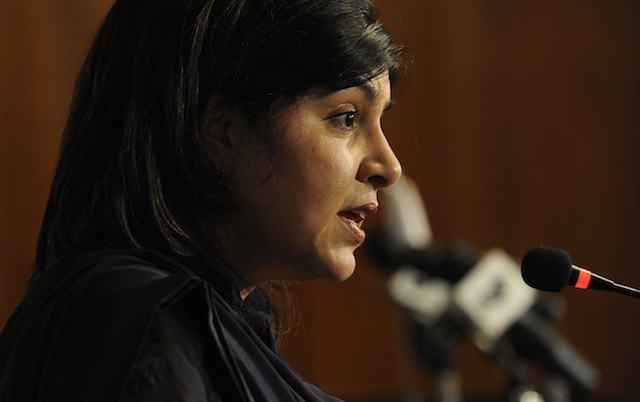
One Muslim determined to not accept that Hamas is the instigator is the UK cabinet minister Baroness Sayeeda Warsi. She resigned from the government in protest over the UK not condemning Israel and not ready to change policies in favor of Hamas. So while she is upset at the loss of Palestinian life (aren't we all), she is silent about the loss of Syrian lives, or Yazidi lives, or for that matter Pakistani lives, all resulting from conflicts with Islamic extremists in various shades of robes or western suits. Photo from www.rappler.com

What's next?

Isn't it time to seriously look at demilitarizing Gaza? Hasn't Hamas shown the world, finally, that it apparently has no intention of governing wisely? With international monitoring and involvement in dispensing resources in this strip, Teatree suspects there would be plenty of new aid money flowing to the Palestinians themselves, which would only raise the pressure to enact a two-state Israel/Palestine solution.

But what is still missing is who would be willing to monitor. Like the Iraqi Prime Minister al-Maliki, Hamas has no intention to cede control, and Teatree suspects there are plenty of proxy Arab supporters (Qatar, Turkey, others) have no interest to see peace breakout.

But nevertheless the equation seems to have changed. Islamic extremism in all its ugly forms is suddenly casting a lot of dreary, repetitious conflicts in new light.

For a final voice, here is a Washington Post opinion piece by Dennis Ross, who served as US President Bill Clinton’s Middle East negotiator and was a special assistant to US President Obama from 2009 to 2011.

Wednesday, August 6, 2014

The Eighth Stan - and the Uighurs who live there

One of the most popular posts in this blog (and the mystery remains as to why) is "The Seven Stans" on June 15, 2010. It described the seven modern day nations that end in "stan." (Ok, a reminder: Pakistan, Afghanistan, Kazakhstan, Kyrgyzstan, Tajikistan, Turkmenistan and Uzbekistan.)

Well, there really is an eighth (and a ninth if one looks at Dagestan, a republic within Russia ... and we may be witnessing the emergence of a tenth called Kurdistan. But those are topics for another day.)

The eighth Stan is currently called Xinjiang, in northwest modern-day China. In an earlier era, this region was known as East Turkestan, but like the much more famous Tibet, this region was swallowed up by the Communists as they created their version of a workers paradise in the late 1940s.

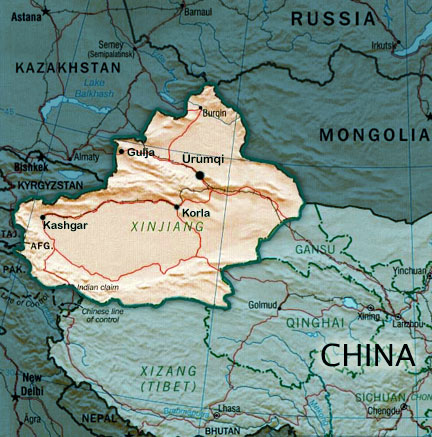
China's largest administrative division, Xinjiang (officially Xinjiang Uyghur Autonomous Region) is nestled in the northwest corner of the People's Republic of China. While it is the largest Chinese administrative division and the 8th largest country subdivision in the world (according to wikipedia), spanning over 1.6 million km2, it is mainly desert, with only about 4 percent fit for human habitation. Graphic from merryabla64.files.wordpress.com

Also historically known as East Turkestan, Xinjiang borders Russia, Mongolia, Kazakhstan, Kyrgyzstan, Tajikistan, Afghanistan, Pakistan and India. It has abundant oil reserves and is China's largest natural gas-producing region. It has a population of 21 million people, dominated (43 percent) by Uighurs. Han Chinese is the next largest group at 41 percent, but has achieved this only after decades of determined ethnic population migration at the behest of the national government. Graphic from www.davidgyoung.com
News trickles out in the form of reporting on unrest and violence in Xinjiang

The New York Times reported on August 3, "It was a bloody week in China’s far west, with nearly 100 people killed in unrest that the authorities have characterized as terrorism but that Uighur advocacy groups have said is a consequence of a sweeping crackdown aimed at silencing opposition to the government’s hard-line policies in the region.

The outbreak of violence in Xinjiang amid an overwhelming show of security appears to be the worst since 2009, when at least 200 people died during several days of ethnic rioting in the regional capital, Urumqi. ..."

Click on image for full picture
Chinese security forces on the move in Xinjiang. Photo from the NY Times

The unrest seems to pop up in various cities of the province. Last week, a Muslim cleric supported by the national government was assassinated in Kashgar, while violence is documented in the cities of Yarkland and Hotan.

Click on image for full picture
Kashgar, in Xinjiang province. Not what one would think of when considering China. www.globalpost.com

Click on image for full picture
Kashgar, and the various oasis in this province are in arid lands. Photo from www.flickr.com

Xinjiang Province, the capital is Urumqi. It is the historic eighth stan, East Turkestan. South of the cities Kashgar and Korla is the forbidding Taklamakan Desert. Graphic from cokesmithphototravel.com

A Guantanamo connection

Perhaps the reader may remember that a group of U.S. Guantanamo prisoners were Uighurs. 22 individuals were swept up in the U.S. counter terrorism actions after the 2001 towers attack, and it got complicated from there. A New York Times article described it this way, "at least as early as 2003, the [U.S] military had determined they were “not affiliated with Al Qaeda or a Taliban leader” and should be released.

But the United States could not repatriate them because the Chinese government has a history of mistreating Uighurs as it deals with ethnic unrest in its vast Central Asian border region of Xinjiang, where Uighurs are the largest ethnic group. The American military believed some of the Uighur detainees had received weapons training at a camp in Afghanistan run by a separatist Uighur group. Other countries were reluctant to take them, in part because of Chinese diplomatic pressure."

The Silk Road connection

The eighth stan and many other stans contain portions of the old Silk Road - an overland trade route connecting the Middle East and China. That could be a story in the future as well.

Click on image for full picture
This map shows the Silk Road, and the region just south of the Tian Shan mountains is that desert ... Graphic from stratfor.com

So there we are - for more fascinating detail on the Uighur's, the politics regarding the eight Stan, visit a blog ... http://www.davidgyoung.com/abused-and-ignored.html

Sunday, July 27, 2014

India challenges international trade agreement over food security

While the world remains fixated, and probably rightly so, on the carnage across the Middle East (ISIS, Syria, Lebanon, Iran, Iraq, Libya, and now once again Hamas and Israel), another meeting occurred in the past two days that nevertheless deserves more attention.

Last Friday at a meeting in Geneva, Switzerland, a reasonably low key meeting of the World Trade Organization (WTO) erupted in anger when India refused to go along with a slide towards greater trade liberalization understandings. Called the Trade Facilitation Agreement (TFA), India signaled it would not sign the document as its food security concerns had not been adequately addressed.

Grain being loaded into ocean going vessel. Grain reserves and ability to move volumes from areas of surplus to areas of need is important, but not to the point of stifling the vitality of local agricultural sectors. Photo from www.telestack.com

In uncharacteristic fashion, India's stance provoked angry rhetoric from the US. "Today we are extremely discouraged that a small handful of members in this organisation are ready to walk away from their commitments at Bali, to kill the Bali agreement, to kill the power of that good faith and goodwill we all shared, to flip the lights in this building back to dark," U.S. Ambassador Michael Punke said in a statement.

In addition, the EU and Australia also sent India a letter stating their concern that the reluctance of India would bring further trade liberalization to a crawl.

What's the issue?

India in the past several rounds of WTO meetings has requested a satisfactory set of guarantees that food security for its millions of poorer citizens would not be jeopardized by further liberalization of food trade. As an article from the www.dnaindia.com describes it in detail:

"The TFA aims to fast track any movement of goods among countries by cutting down bureaucratic obligations. The problem with TFA runs in a clause that says farm subsidies cannot be more than 10 percent of the value of agricultural production. If the cap is breached, other members can challenge it and also go on to impose trade sanctions on the country.

The developing countries would have a problem with the solutions offered by the developed countries as without the subsidies the food security of the developing nations could be seriously harmed. India agreed to the TFA in Bali only under the condition that interim relief would be provided to the developing nations. It said no legal actions or sanctions would be imposed on the developing nations till 2017, by which time a solution would be worked out among the nations. However, this interim relief would not be applicable if such subsidies would lead to trade distortions, by which one means, that prices of exports and imports cannot be affected by this.

India's Food Security Act, which is binding on the government by law now, implies that the government will provide very cheap food to the most vulnerable part of the population at extremely low prices. Apart from providing subsidies to the consumers, through the public distribution system, it also provides subsidies to the producers of food grains. So it buys food grains from farmers at a minimum support price, and subsidizes inputs like electricity and fertilizer.

The first problem is with the 10% cap on subsidies which will not be possible for India to achieve. Adding to the woes is the fact that the 10% cap is calculated based on 1986-88 prices when the prices of food grains were much lower. So the cap has to be updated taking into account the present prices of foodgrains.

The second problem is that even for providing subsidized food, India will have to open up its own stockpiling to international monitoring. It will not be able to add protein heavy grains like say, lentils, if it wants to, due to riders in the peace clause.

Third, it might seem unfair to developing countries to not crack down on farm subsidies that the United States provides to its farmers to the tune of more than $20 billion per year. While the WTO is binding the developing countries to protocols, the issue of subsidies by developed giants like US seems to be off the table."

Observations

India's new prime minister Modi is bringing some backbone to the world stage. Good for him.

India's new Prime Minister, Narendra Modi. Photo from www.thenews.com.pk

US Ambassador Punke is sounding like a punk. When one of the countries objecting to the TFA happens to be the 2nd most populous nation on earth, his description of "small handful of members" mis-characterizes the size and importance of the objection.

Michael Punke serves as Deputy United States Trade Representative and U.S. Ambassador and Permanent Representative to the World Trade Organization (WTO) in Geneva, Switzerland. (Teatree has no idea whether Punke is a punk, he might be a nice guy. But the criticism stands ...) Photo from en.mercopress.com

New leader of the WTO, Brazilian diplomat Roberto Carvalho de Azevedo, now has some serious work cut out for him. Teatree sincerely wishes him success in satisfying that "small member" India, while moving trade liberalization forward.

Azevedo leads the WTO, and his diplomatic skills are about to be called upon. Photo from inspirerende.wordpress.com

Western countries do subsidize their agricultural systems heavily, and don't like anyone pointing that out. Food security for any nation should be high priority. Subsidies - such as cheap bread in Egypt and several other countries - may not be efficient, but Teatree is all for supporting local home grown food programs and resisting cheap grain by the ship from nations which have industrialized their own food growing sector.

Food production in India may be outdated and inefficient, but there is a fine line between pulling the rug out from under a vital rural lifestyle and substituting efficient large farm systems leaving significant segments of poor rural citizens with little skills for other work. Photo from www.rural.nic.in

This is ALWAYS an under-the-radar issue for the West which works best when kept low key. Hear, hear for India to bring it to the surface.

Sunday, June 29, 2014

Refugees and other flows from regional conflicts grow

"The first casualty, when war comes, is truth" is a statement that has been often repeated and modified. It is attributed to Hiram Johnson (1866-1945), a "staunchly isolationist" Republican senator from California in reference to World War 1. (Hmmm, the 100th anniversary of what is considered the precipitant act of that war was held this week. As the Australian Broadcasting Service (ABC) concisely summarizes, "the Archduke Ferdinand - the heir to the Austro-Hungarian throne - was shot dead with his wife Sophie on a June morning in 1914. Ferdinand's murder by Gavriol Princip, a 19-year-old Bosnian Serb, set the Great Powers marching to war. More than 10 million soldiers died, as empires crumbled and the world order was rewritten.")

Click on image for full picture
Yes, the 100th year commemoration of the assassination, carried out by the Bosnian, Gariol Princip, was held in Sarajevo, Bosnia and Herzegovina, but not without controversy!. Apparently the killing is seen very differently by Bosnians, Croats, and Serbs. To some in Bosniak parts of the country, Princip was a terrorist; to some Serbs, he is largely viewed as an ethnic Serb nationalist, while others see in him a pan-Slav idealist. In this picture by the BBC, a Serbian flag is carried in the eastern B-H town of Visegrad at a separate commemoration more sympathetic of Princip.

So where was I? Teatree's POINT is that one could come up with other firsts besides truth being the first casualty. While there is little doubt that truth is quick to go - yes, yes, and yes - Teatree observes that the wrenching of civilians from their homes may even come sooner.

Three refugee flows

Inside Iraq

We've read much of Syria's streams of civilians heading to Turkey and Jordan - hundreds of thousands - and some were even a couple years ago fleeing to Iraq. But with ISIS in Syria and Iraq making the news this past two weeks, tens of thousands of Iraqis themselves are fleeing in all directions - mainly to safe parts of their now divided country.

Click on image for full picture
Iraqis from Mosul fled everywhere, but many into the autonomous Kurdish controlled region. Photo from redstate.com

Between Russia and the Ukraine

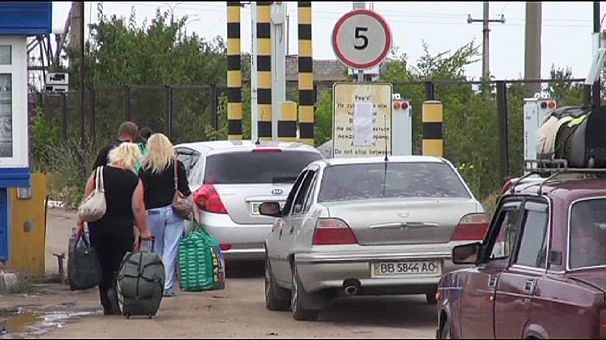
There are thousands on the roads in Eastern Ukraine. Some are heading to Russia or pro-Russian strongholds in the east of the country, while some Eastern Ukrainians are headed west to safer Ukrainian territory. The UN puts a number on internal movements - 54,000 - but notes that another 110,000 Ukrainians have gone to Russia since the first of the year.

Click on image for full picture
Pro-Russian civilians (or those simply concerned for their families' safety) going through border crossing into Russia. Photo from www.euronews.com

From Central America to the U.S.

There isn't exactly a war or conflict going on in several Central American countries - Honduras, El Salvador, Guatemala, - but it is clearly a desperate situation that stems from poverty, the rise of gangs, and violence of drug cartels in these small nations. What is unique is that children are being sent on their own to the U.S., no doubt assuming the U.S. is much less likely to return children than it would adults traveling alone.

Click on image for full picture
Central American families (not strictly just children) arriving in great numbers. An ABC article states, "The Department of Homeland Security says more than 52,000 unaccompanied minors have been detained along the U.S. border with Mexico this fiscal year. In addition, authorities have apprehended 39,000 adults with small children. The numbers reflect a significant uptick over last year, when just 24,000 unaccompanied minors were apprehended. The majority in the surge hail from Central American countries, and a disproportionate number are young women and under age 13, officials say." Photo from rt.com

Click on image for full picture
Countries under great stress, and parents sending children north Graphic from Mother Jones.com

One other flow

We've seen it before: in Libya after the overthrow of Gaddafi, unsecured weaponry flooded North African countries, and many say these weapons fueled the uptick of strength in Boko Haram and was responsible for the surge of conflict in Mali.

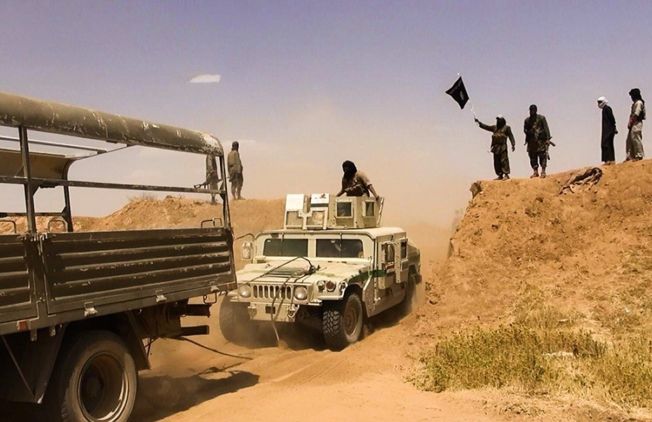
Today, a new flood of weapons is on the move. In Iraq, vast amounts of weaponry, along with vehicles and armor, changed hands. It came from Iraqi army units that melted in front of ISIS fighters, and immediately seized by ISIS itself.

Click on image for full picture
This graphic shows, if nothing else, that the border between Iraq and Syria is for now, a moot boundary. A sand berm that once delineated the line was bulldozed out by ISIS forces. ISIS or ISIL? These are Western terms, the militants refer to themselves as simply jihadis for "al-Dawla", Arabic for the State. That's the main point, they don't view the Syrian or Iraq boundaries as significant, as they are trying to establish their own Caliphate. Graphic from the BBC

Click on image for full picture
Not "just" small arms, but vehicles, tanks, missiles - and in many cases American made - have passed into ISIS hands. These incidentally are coming through early breaks in the sand berm that once delineated Syria from Iraq. Photo from www.vg.no

And so they go ...


Saturday, June 21, 2014

Celebrating winter solstice in Tasmania

With so much grim material to cover, let's duck and enjoy, rather, a solstice moment.

In Southern Australia, Aussies celebrate the longest night of the year with a Dark Mofo event - make that a week long event. Specifically in Hobart, Australia, the celebration includes what some call a Beach Bum swim ...

Click on image for full picture
Hobart, one of the southernmost cities of Australia and the capital of the island-state of Tasmania. Graphic from www.vacationstogo.com

Click on image for full picture
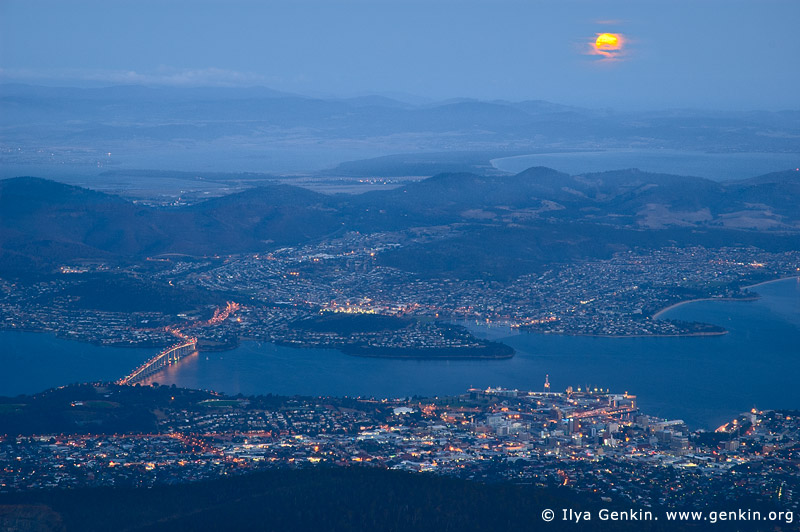
The city itself, home to two fifths of the island's population of a little of 510,000, seems like a pretty picturesque locale. Photo from www.genkin.org

So, it's cold there the 21st of June, the swim short and unique, and then there are fireworks, concerts, etc.

Click on image for full picture
The Beach Bum swim. Photo from tasmaniantimes.com

Click on image for full picture
Apparently, the "Sky Whale" is an annual participant in Dark Mofo. Photo from prelive.themercury.com.au

Sky Whale over Hobart, yes, those are multiple teats. Photo from lipmag.com

And there are kid friendly venues as well

Click on image for full picture
An American TV show full of characters, Yo Gabba Gabba, is participating in Dark Mofo this year. Teatree admits to having bought a stuffed toy a few years ago that resembles the green creature. Photo from www.racv.com.au

And so the days will soon begin to lengthen