North Korea

North Korea
The always bombastic and unpredictable North Koreans go hysterical again. This time the country is prepared to "go to war" with South Korea because that country is playing loudspeakers directed at North Korean territory. A headline from a UK paper reads, "More than 50 North Korea submarines 'leave their bases' as war talks with South continue "

Sunday, July 27, 2014

India challenges international trade agreement over food security

While the world remains fixated, and probably rightly so, on the carnage across the Middle East (ISIS, Syria, Lebanon, Iran, Iraq, Libya, and now once again Hamas and Israel), another meeting occurred in the past two days that nevertheless deserves more attention.

Last Friday at a meeting in Geneva, Switzerland, a reasonably low key meeting of the World Trade Organization (WTO) erupted in anger when India refused to go along with a slide towards greater trade liberalization understandings. Called the Trade Facilitation Agreement (TFA), India signaled it would not sign the document as its food security concerns had not been adequately addressed.

Grain being loaded into ocean going vessel. Grain reserves and ability to move volumes from areas of surplus to areas of need is important, but not to the point of stifling the vitality of local agricultural sectors. Photo from www.telestack.com

In uncharacteristic fashion, India's stance provoked angry rhetoric from the US. "Today we are extremely discouraged that a small handful of members in this organisation are ready to walk away from their commitments at Bali, to kill the Bali agreement, to kill the power of that good faith and goodwill we all shared, to flip the lights in this building back to dark," U.S. Ambassador Michael Punke said in a statement.

In addition, the EU and Australia also sent India a letter stating their concern that the reluctance of India would bring further trade liberalization to a crawl.

What's the issue?

India in the past several rounds of WTO meetings has requested a satisfactory set of guarantees that food security for its millions of poorer citizens would not be jeopardized by further liberalization of food trade. As an article from the www.dnaindia.com describes it in detail:

"The TFA aims to fast track any movement of goods among countries by cutting down bureaucratic obligations. The problem with TFA runs in a clause that says farm subsidies cannot be more than 10 percent of the value of agricultural production. If the cap is breached, other members can challenge it and also go on to impose trade sanctions on the country.

The developing countries would have a problem with the solutions offered by the developed countries as without the subsidies the food security of the developing nations could be seriously harmed. India agreed to the TFA in Bali only under the condition that interim relief would be provided to the developing nations. It said no legal actions or sanctions would be imposed on the developing nations till 2017, by which time a solution would be worked out among the nations. However, this interim relief would not be applicable if such subsidies would lead to trade distortions, by which one means, that prices of exports and imports cannot be affected by this.

India's Food Security Act, which is binding on the government by law now, implies that the government will provide very cheap food to the most vulnerable part of the population at extremely low prices. Apart from providing subsidies to the consumers, through the public distribution system, it also provides subsidies to the producers of food grains. So it buys food grains from farmers at a minimum support price, and subsidizes inputs like electricity and fertilizer.

The first problem is with the 10% cap on subsidies which will not be possible for India to achieve. Adding to the woes is the fact that the 10% cap is calculated based on 1986-88 prices when the prices of food grains were much lower. So the cap has to be updated taking into account the present prices of foodgrains.

The second problem is that even for providing subsidized food, India will have to open up its own stockpiling to international monitoring. It will not be able to add protein heavy grains like say, lentils, if it wants to, due to riders in the peace clause.

Third, it might seem unfair to developing countries to not crack down on farm subsidies that the United States provides to its farmers to the tune of more than $20 billion per year. While the WTO is binding the developing countries to protocols, the issue of subsidies by developed giants like US seems to be off the table."

Observations

India's new prime minister Modi is bringing some backbone to the world stage. Good for him.

India's new Prime Minister, Narendra Modi. Photo from www.thenews.com.pk

US Ambassador Punke is sounding like a punk. When one of the countries objecting to the TFA happens to be the 2nd most populous nation on earth, his description of "small handful of members" mis-characterizes the size and importance of the objection.
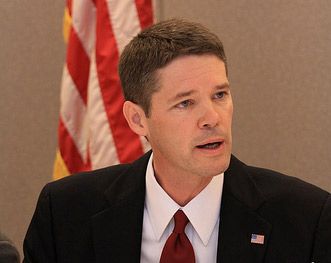
Michael Punke serves as Deputy United States Trade Representative and U.S. Ambassador and Permanent Representative to the World Trade Organization (WTO) in Geneva, Switzerland. (Teatree has no idea whether Punke is a punk, he might be a nice guy. But the criticism stands ...) Photo from en.mercopress.com

New leader of the WTO, Brazilian diplomat Roberto Carvalho de Azevedo, now has some serious work cut out for him. Teatree sincerely wishes him success in satisfying that "small member" India, while moving trade liberalization forward.

Azevedo leads the WTO, and his diplomatic skills are about to be called upon. Photo from inspirerende.wordpress.com

Western countries do subsidize their agricultural systems heavily, and don't like anyone pointing that out. Food security for any nation should be high priority. Subsidies - such as cheap bread in Egypt and several other countries - may not be efficient, but Teatree is all for supporting local home grown food programs and resisting cheap grain by the ship from nations which have industrialized their own food growing sector.

Food production in India may be outdated and inefficient, but there is a fine line between pulling the rug out from under a vital rural lifestyle and substituting efficient large farm systems leaving significant segments of poor rural citizens with little skills for other work. Photo from www.rural.nic.in

This is ALWAYS an under-the-radar issue for the West which works best when kept low key. Hear, hear for India to bring it to the surface.

Sunday, June 29, 2014

Refugees and other flows from regional conflicts grow

"The first casualty, when war comes, is truth" is a statement that has been often repeated and modified. It is attributed to Hiram Johnson (1866-1945), a "staunchly isolationist" Republican senator from California in reference to World War 1. (Hmmm, the 100th anniversary of what is considered the precipitant act of that war was held this week. As the Australian Broadcasting Service (ABC) concisely summarizes, "the Archduke Ferdinand - the heir to the Austro-Hungarian throne - was shot dead with his wife Sophie on a June morning in 1914. Ferdinand's murder by Gavriol Princip, a 19-year-old Bosnian Serb, set the Great Powers marching to war. More than 10 million soldiers died, as empires crumbled and the world order was rewritten.")

Click on image for full picture
Yes, the 100th year commemoration of the assassination, carried out by the Bosnian, Gariol Princip, was held in Sarajevo, Bosnia and Herzegovina, but not without controversy!. Apparently the killing is seen very differently by Bosnians, Croats, and Serbs. To some in Bosniak parts of the country, Princip was a terrorist; to some Serbs, he is largely viewed as an ethnic Serb nationalist, while others see in him a pan-Slav idealist. In this picture by the BBC, a Serbian flag is carried in the eastern B-H town of Visegrad at a separate commemoration more sympathetic of Princip.

So where was I? Teatree's POINT is that one could come up with other firsts besides truth being the first casualty. While there is little doubt that truth is quick to go - yes, yes, and yes - Teatree observes that the wrenching of civilians from their homes may even come sooner.

Three refugee flows

Inside Iraq

We've read much of Syria's streams of civilians heading to Turkey and Jordan - hundreds of thousands - and some were even a couple years ago fleeing to Iraq. But with ISIS in Syria and Iraq making the news this past two weeks, tens of thousands of Iraqis themselves are fleeing in all directions - mainly to safe parts of their now divided country.

Click on image for full picture
Iraqis from Mosul fled everywhere, but many into the autonomous Kurdish controlled region. Photo from redstate.com

Between Russia and the Ukraine

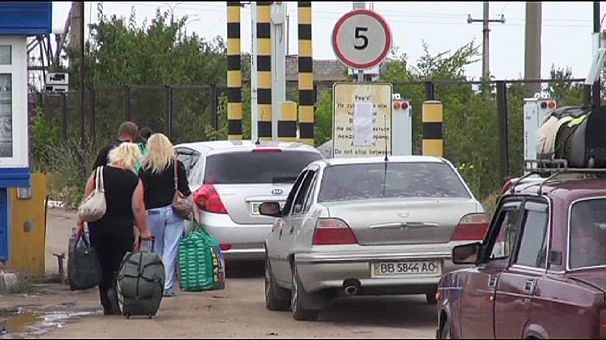
There are thousands on the roads in Eastern Ukraine. Some are heading to Russia or pro-Russian strongholds in the east of the country, while some Eastern Ukrainians are headed west to safer Ukrainian territory. The UN puts a number on internal movements - 54,000 - but notes that another 110,000 Ukrainians have gone to Russia since the first of the year.

Click on image for full picture
Pro-Russian civilians (or those simply concerned for their families' safety) going through border crossing into Russia. Photo from www.euronews.com

From Central America to the U.S.

There isn't exactly a war or conflict going on in several Central American countries - Honduras, El Salvador, Guatemala, - but it is clearly a desperate situation that stems from poverty, the rise of gangs, and violence of drug cartels in these small nations. What is unique is that children are being sent on their own to the U.S., no doubt assuming the U.S. is much less likely to return children than it would adults traveling alone.

Click on image for full picture
Central American families (not strictly just children) arriving in great numbers. An ABC article states, "The Department of Homeland Security says more than 52,000 unaccompanied minors have been detained along the U.S. border with Mexico this fiscal year. In addition, authorities have apprehended 39,000 adults with small children. The numbers reflect a significant uptick over last year, when just 24,000 unaccompanied minors were apprehended. The majority in the surge hail from Central American countries, and a disproportionate number are young women and under age 13, officials say." Photo from rt.com

Click on image for full picture
Countries under great stress, and parents sending children north Graphic from Mother Jones.com

One other flow

We've seen it before: in Libya after the overthrow of Gaddafi, unsecured weaponry flooded North African countries, and many say these weapons fueled the uptick of strength in Boko Haram and was responsible for the surge of conflict in Mali.

Today, a new flood of weapons is on the move. In Iraq, vast amounts of weaponry, along with vehicles and armor, changed hands. It came from Iraqi army units that melted in front of ISIS fighters, and immediately seized by ISIS itself.

Click on image for full picture
This graphic shows, if nothing else, that the border between Iraq and Syria is for now, a moot boundary. A sand berm that once delineated the line was bulldozed out by ISIS forces. ISIS or ISIL? These are Western terms, the militants refer to themselves as simply jihadis for "al-Dawla", Arabic for the State. That's the main point, they don't view the Syrian or Iraq boundaries as significant, as they are trying to establish their own Caliphate. Graphic from the BBC

Click on image for full picture
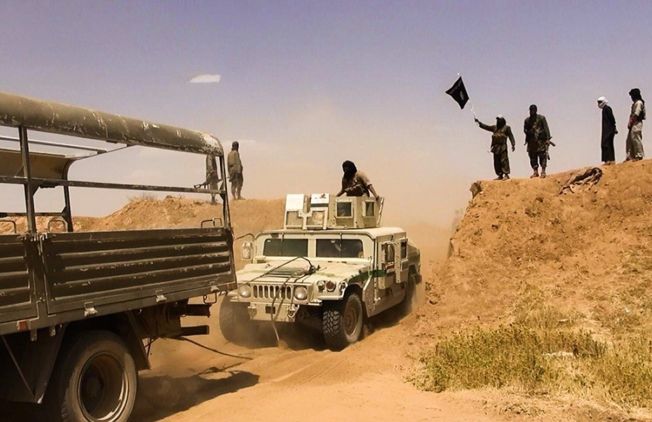
Not "just" small arms, but vehicles, tanks, missiles - and in many cases American made - have passed into ISIS hands. These incidentally are coming through early breaks in the sand berm that once delineated Syria from Iraq. Photo from www.vg.no

And so they go ...


Saturday, June 21, 2014

Celebrating winter solstice in Tasmania

With so much grim material to cover, let's duck and enjoy, rather, a solstice moment.

In Southern Australia, Aussies celebrate the longest night of the year with a Dark Mofo event - make that a week long event. Specifically in Hobart, Australia, the celebration includes what some call a Beach Bum swim ...

Click on image for full picture
Hobart, one of the southernmost cities of Australia and the capital of the island-state of Tasmania. Graphic from www.vacationstogo.com

Click on image for full picture
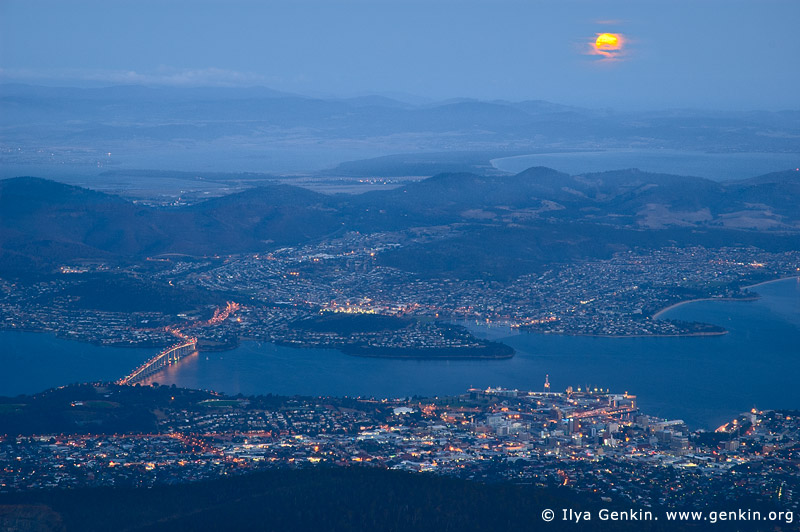
The city itself, home to two fifths of the island's population of a little of 510,000, seems like a pretty picturesque locale. Photo from www.genkin.org

So, it's cold there the 21st of June, the swim short and unique, and then there are fireworks, concerts, etc.

Click on image for full picture
The Beach Bum swim. Photo from tasmaniantimes.com

Click on image for full picture
Apparently, the "Sky Whale" is an annual participant in Dark Mofo. Photo from prelive.themercury.com.au

Sky Whale over Hobart, yes, those are multiple teats. Photo from lipmag.com

And there are kid friendly venues as well

Click on image for full picture
An American TV show full of characters, Yo Gabba Gabba, is participating in Dark Mofo this year. Teatree admits to having bought a stuffed toy a few years ago that resembles the green creature. Photo from www.racv.com.au

And so the days will soon begin to lengthen

Monday, June 16, 2014

Iraq, left on its own, backed to the edge

The news from Iraq this week has been bad. Very bad. A growing body of Islamic extremists, gathered from a territory carved out of Eastern Syria during the ongoing Syrian civil war, calling themselves the Islamic State of Iraq and Syria (ISIS), has exploded into Sunni lands in eastern Iraq.

Taking advantage of the poor and divisive governance by Iraqi leader Maliki, ISIS has played on the resentment of Sunnis, chasing a shocked Iraqi army from several cities including Iraq's second largest city, Mosul.

The interesting presentation in this BBC graphic, shows thin little yellow lines as the controlled territory of ISIS. What is really is showing is that the Iraqi population and cities of Western Iraq are for the most part along waterways, the vacant land inbetween is simply empty desert.

Click on image for full picture
Al Raqqa, Syria, has long been in the hands of anti-Assad rebels, and has become, unfortunately, the urban headquarters for ISIS, one of the most ruthless factions of Islamic extremists. Photo from www.timesofisrael.com

So, the first point suggested by Teatree to muse upon, is that due to Western inaction to support moderate Syrian opposition, extremists have consolidated their control of the anti-Assad forces. Not only do they want to remove Assad - the chemical weapons user who has just manipulated his third Presidential term - but more importantly establish their own "Caliphate." Just as the Taliban gained an actual footprint in ruling Afghanistan in the 1990s, ISIS now has a base, and it has gained it in the middle of the Syrian civil war.

Iraq, left to itself, sinks into sectarianism

In the West, the US and UK in particular, the shocking collapse of Iraq has quickly degenerated to large degree into a rehash of whether President Bush and Prime Minister Tony Blair are either completely, or mainly to blame.

What can at least be said is that Iraqi President Maliki has done nothing, really, to attempt to create a big house government, including Sunnis and the Kurds in the past 8 or so years. Becoming more sectarian, ie, favoring his fellow Shiites, Maliki has by neglect lost most of the country (For a detailed description of Maliki's rule, read the New York Time link in the comment section). The Sunnis are hostile, and unfortunately choosing badly in accepting (or tolerating) ISIS gains. The Kurds, on the other hand, have never felt part of a national Iraqi identity, and in the midst of this recent chaos have quickly moved to consolidate their hold on Kurd land in Northeast Iraq.

Click on image for full picture
Kurds have consolidated their hold in Iraq's northeast, Sunnis have marginalized themselves to the west, and dabble dangerously with ISIS (or alternatively ISIL), while the Shia homeland in SE Iraq is in danger of becoming a vassal of Shia Iran. Graphic taken from a CBC.ca article

One point of debate

US President Obama, fulfilling a political campaign promise, quickly pulled all US troops out of Iraq within three years of being in office. One could say, and many do, that he left a fragile - clearly fragile - nascent democracy surrounded by hostile or indifferent neighbors and plenty of internal strife. Yet no stabilizing force at all could be left there, the White House explains, because the two countries could not agree on future immunity for US forces if they were to remain in the country. Teatree will only point out that it seems the US was excruciatingly polite in negotiations to so quickly give in to this one country. Given the US propensity during the same time and continuing to this day, to strike targets repeatedly at will with drones in Pakistan, Afghanistan, Yemen, and Somalia, with or without those nation's official approval, one can only wonder whether a political promise was the major reason for such a complete hasty Iraqi withdrawal, regardless of the consequences which we are now witnessing.
In contrast, after the Balkan war ended in the mid-90s, nearly 50,000 NATO troops stayed to ensure the peace, building fragile bridges between wounded and wary ethnic populations for several years, before slowly winding down their presence. Even today, 20 years later, over 5000 troops remain. One could highlight the value of stabilizing forces in South Korea, Japan, and even Germany for decades, but that would belabor the point.

KFOR troops in Kosovo, keeping the fragile peace between neighboring Serbia and Muslim Kosovans, and earlier between a number of nations, Croatia, Republic of Bosnia and Herzegovina, Slovenia, etc. Photo from fredbellomy.com

Iran steps closer to Shia arc
Iran, already pleased with Maliki in Iraq, have offered him assistance in fighting ISIS. With this opening to create a closer relationship with Iraq, Iran moves towards its long term goal of establishing an arc of influence: from Iran into Syria where it supports Assad, and linking with Hezbollah in Lebanon. Now with Iraq on the edge, the possibility of an uninterrupted arc is within reach. And while Russia has robustly supported chemical-weapons man Assad in Syria, in contrast the West timidly continues its searches for appropriate groups it might support among the Syrian opposition. (Hint - these moderate groups have long since left the building ...).

The current three - Hezbollah's Nasrullah, left; Iran's Rouhani, center; and chemical-man Assad from Syria on the right. Suddenly the three buddies have half of Iraq in their pocket, with just ISIS rabble to clear out in-between. Poster photo from irannewsupdate.com

What's ahead?
Aside from sectarian bloodletting on a scale we've not seen yet even in Syria or during the US occupation of Iraq, we are possibly seeing a preview of what lies ahead in Afghanistan as soon as the US pulls its combat troops out by the end of this year, and even the trailing training force of 10,000 within a year after that.

What else? Under this current US administration, the West is likely to retreat to a limp posture of the past - lobbing a few tomahawk missiles here and there, and launching more drone strikes safely from a distance, though no doubt without anyone's permission. That fastidiousness of gaining permission was reserved for the former Iraq alone.

Click on image for full picture
Drone strikes are apparently the US default strategy (permission granted or not), with no chance for immediate battlefield death or injury for US armed forces. But doesn't it appear that the U.S. might be losing a bit of the "hearts and minds" battle? Photo from org.salsalabs.com

Certainly there will be no large scale commitment of US combat troops back into the Iraqi theater - that ship has sailed. Though how US troops in Kuwait will somehow remain exempt from extremist attacks remains to be seen. And our erstwhile allies Jordan and Israel may also believe our reassurances of steadfast US support leaves something to be desired.

And onward the world moves ...

Sunday, June 8, 2014

Putin's Russia searches for partners

On May 29, Russian President Putin stood with two national leaders from Belarus and Kazakhstan, to announce the formation of a rival to the European Union (EU), called the Eurasian Economic Union (EaEU). The three countries would provide an alternative economic trading zone to the EU, with the intent of attracting other countries, one assumes, who are unable to become members of the EU. Both Armenia and Kyrgyzstan have indicated their interest in becoming members

Click on image for full picture
The founding members of the Eurasian Economic Union - from left, President Alexander Lukashenko of Belarus, President Nursultan Nazarbayev of Kazakhstan, and President Putin of Russia. Photo from www.uznews.net

Click on image for full picture
Here in Cyrillic script, are the founding EaEU members. The gray vacancy in the southwest of the map is Ukraine, which at one point, no doubt, was assumed to become a founding partner in this alternative to the EU. Graphic from democraticbelarus.eu

Critics consider the EaEU as a Putin effort to revive the soviet empire without the communist ideology. Ukraine, however, is missing. In fact, Ukraine was trying to move towards the EU over the past years, which ultimately led to Putin's clampdown and annexation of the Crimean peninsula, as well as fueling separatist movements throughout the east of the country.

President Putin called the official establishment of the EaEU as the "central event of the year" (apparently surpassing his annexation exercise), but even among the founding three members, there was hesitation. As one article from uznews observed, "It should be noted that the signing of the document did not go as planned by Moscow. Kazakhstan, for instance, spoke out against “Russian revenge-seeking” and decided to not include such “murky” points as “common citizenship”, “foreign affairs”, “passport and visa regimes”, “common borders”, “inter-parliamentary cooperation”, and “export control”.

Belarus also signed the agreement with many corrections having rejected allegations of its economic and political weakness while its leader, Alexander Lukashenka, underscored more than once that his country is entering the union as an equal partner and will not tolerate any infringements on its sovereignty."

Click on image for full picture
The new EaEU is most likely the latest attempt to solidify the influence of Russia with its neighbors. After the collapse of the Soviet Union in 1990, there was much fanfare over the Commonwealth of Independent States (CIS) which, who knows, perhaps was trying, at least with the name, to imitate the British Commonwealth. Even then, the three Baltic states had quickly and emphatically moved away from CIS consideration. Graphic from www.canros.com

Other Putin moves:

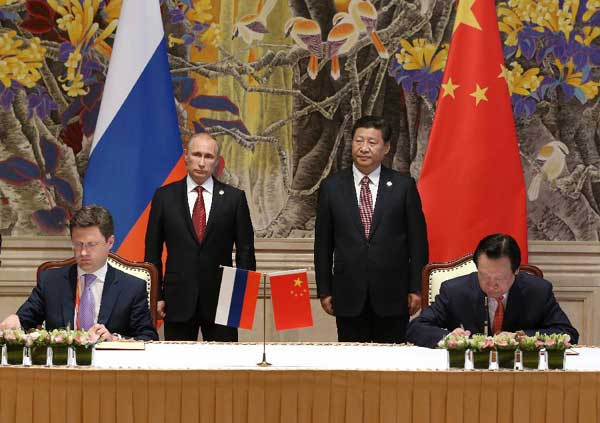
Defiant of Western sanctions for his land grab on the Crimean Peninsula, Russian President Putin also trumpeted a long term energy deal with China, selling up to $400 billion of oil and gas over 30 years. This time Putin called the deal, a “watershed event.” The agreement includes building new pipelines and terminals heading away from Europe, where most of Russia's oil and gas exports now flow. $400 billion sounds like a lot, but with Putin plowing $50 billion into the Sochi winter Olympics alone, it can be squandered ...

Click on image for full picture
Russian President Putin and Chinese President Xi Jinping at oil and gas agreement event The previous day, the two countries announced a broader energy cooperation framework agreement. Photo from cntv.cn

Click on image for full picture
Lots of new pipelines over extensive miles - all concentrated in the east of Russia and headed towards China. Graphic found in www.srbijadanas.net

Secondly, and perhaps not completely unrelated, a prospective EaEU member, Kyrgyzstan has concluded its agreement with the United States in which it provided an airbase at Manas for NATO operations in Afghanistan. While the timetable was agreed on several years ago, its coincidental timing emphasizes Russia's efforts to consolidate its previous allied borders.

The US Manas air force base in Bishkek, Kyrgyzstan ... Photo from defence.pk

From a Washington Post article, we read, "Kyrgyzstan, a mainly Muslim nation of 5.5 million, remains poor and volatile after violent revolts that have deposed two presidents since 2005. It lies on a drug-trafficking route out of Afghanistan and is next door to China, which is boosting its economic ties with resource-rich Central Asia. After his election in 2011, Kyrgyz President Almazbek Atambayev assured Moscow the U.S. air base would be shut.

In December 2012 he ratified a deal leasing the base to Russia for 15 years from January 2017, after Moscow agreed to write off some $500 million of Kyrgyz debts. The agreement can be automatically extended for five years after its expiry. Neighboring Tajikistan also receives Russian economic aid and ratified a deal in October to extend by three decades Moscow's military presence on its land, which may face security threats after NATO troops leave Afghanistan by the end of 2014."

Click on image for full picture
With the Western war effort quickly winding down in Afghanistan, the US is relinquishing its Kyrgystan air base and will accomplish any further resupplying by air from Romania ... It looks like a stretch, but then again, the US seems to have every intention of leaving Afghanistan, as well as leaving the country to an even more uncertain future. Graphic from www.stripes.com

Sunday, May 25, 2014

Elections for the EU, Lithuania, and Ukraine

One could write about elections in one form or another each week all year: real ones, important ones, fake ones, rigged ones, disappointing ones. Then there are periodic changes in absolute monarchies, family dynasties, military takeovers, and various forms of anarchy and failed states. The world is really in a constant churn ...

Across Europe, there were elections this past week where European Union countries held votes to select their nations' representation in the European Union Parliament.

Click on image for full picture
The 28 member nations of the European Union. There are six additional countries in the midst of formal membership inclusions steps: Iceland, Montenegro, Serbia, The former Yugoslav Republic of Macedonia, and Turkey. Other countries, including Ukraine, wish to formally enter the long process of becoming EU members. Graphic from http://3cursa.wikispaces.com

From the EU website, "The EU is a unique economic and political partnership between 28 European countries that together cover much of the continent. The EU was created in the aftermath of the Second World War. From the EU website itself, "The first steps were to foster economic cooperation: the idea being that countries who trade with one another become economically interdependent and so more likely to avoid conflict. The result was the European Economic Community (EEC), created in 1958, and initially increasing economic cooperation between six countries ... Since then, a huge single market has been created and continues to develop towards its full potential.

What began as a purely economic union has evolved into an organisation spanning policy areas, from development aid to environment. A name change from the EEC to the European Union (EU) in 1993 reflected this. The EU is based on the rule of law: everything that it does is founded on treaties, voluntarily and democratically agreed by all member countries. These binding agreements set out the EU's goals in its many areas of activity: Mobility, growth, stability and a single currency.

The EU has delivered half a century of peace, stability and prosperity, helped raise living standards, and launched a single European currency, the euro. Thanks to the abolition of border controls between EU countries, people can travel freely throughout most of the continent. And it's become much easier to live and work abroad in Europe. The single or 'internal' market is the EU's main economic engine, enabling most goods, services, money and people to move freely..."

Click on image for full picture
A big EU parliament at work, headquartered in Brussels, Belgium. Photo from www.enet.gr

This week's elections, however, found plenty of Europeans voting for Euro-skeptics, with a few parties and individuals standing out. These new voices have serious reservations about the reach and scope of the organization, even as most member nations are fretting over Russian expansion in Ukraine and Georgia. In particular, there are high tensions over immigration, and financial bailouts for poor performing EU member states.

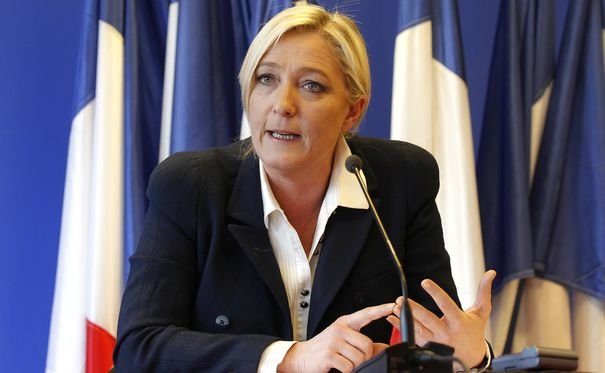
One of the more dramatic results was in France where Marine Le Pen, leader of the National Front party could find itself with 25 seats, up from just 3 seats in 2009.

Click on image for full picture
Marine Le Pen, leader of the National Front party, holds just two seats in France's parliament, but 23-25 in France's allotment of 74 seats in the EU. Photo from scenarieconomici.it

In the UK, the Euroskeptic UKIP party leading for the most seats of the 74 alloted to that country, with similar skepticism finding voice in other EU countries - Denmark and Hungary for two.

The EU parliament has approximately 750 seats, seemingly unwieldy, but once the votes settle in with firmer numbers, there will no doubt still be a majority in full accord with EU goals and vision. Germany in particular, with the largest number of seats (96) in the EU parliament, maintains its orientation towards European integration (though with tough financial standards).

Click on image for full picture
A Slovenian representative (left) speaks with German delegates at a recent EU gathering. The recent surge in EU skeptics will likely mean a "rightward" tack in the organization, where certain issues will be dealt with than others, but not a breakdown in the entity by any means. Photo from ec.europa.eu (Dr. Janez Potoċnik, Slovenia)

But there is unrest in the organization, somehow similar yet much more complex than the United States where 435 members of Congress representing 315 million are polarized (but at least speaking American english). Imagine the complexity of the EU with 500 million citizens, and dozens of languages. The EU in that sense is closer to India, with its dozens of languages, religions, and 790 seats (though outpacing either the US or EU, with 1.2 billion citizens).

In Europe especially, immigration concerns and strong nationalistic strains tend to bring up reminders of the dangers of far right ideologies - overt anti-semitism and fascism - so separating true concerns from these more extreme views will be the challenge.

On to the Ukraine

It appears that a billionaire who runs a chocolate industry in the Ukraine will be the next President of this fractured country. Petro Poroshenko, aka the "Chocolate King," won more than 50% of the vote, which avoided a runoff in June. A former economics and foreign minister, ironically, he served in the cabinet of his the previous ousted President Viktor Yanukovych. Mr Poroshenko has major challenges ahead, to say the least: armed pro-Russian separatists, and big natural gas bills to be paid might top the list.

New Ukraine President Poroshenko, with wife Marina behind to the right speaking to the press. Photo from www.veooz.com

On to Lithuania

In contrast to the surprise of the EU elections, and to the drama in Ukraine, there is a steadier election result in the small Baltic state of Lithuania.

Lithuania, with a population of just over 3 million, also has similar tensions between its native Lithuania population and a sizable presence of Russians - a legacy from the Soviet Empire days. Graphic from geography.howstuffworks.com

Dalia Grybauskaite won her second term as President of this country, and she ran her campaign on a tough stance towards Russian expansionism. As one article writes, "President Grybauskaite has welcomed the presence of NATO troops in Lithuania since the upheaval in Ukraine. The 58-year-old president has a karate black belt and promised during the campaign that she would not be intimidated by Russian aggression, saying "I'll take a gun myself to defend the country if that what's needed for national security."

Click on image for full picture
2nd term Lithuania President Dalia Grybauskaite has no illusions regarding Russia, based on her country's experience under Soviet occupation after WWII, and the most recent Russian generated uproar in the Crimea and Eastern Ukraine. Photo from www.15min.lt

Another article notes the Presidential election came as Russia's annexation of Ukraine's former Crimean peninsula and "sabre rattling in the neighbouring Russian exclave of Kaliningrad have sparked deep seated fears in Lithuania .... Grybauskaite first urged and then welcomed the arrival of American troops last month as NATO stepped up its presence in the Baltic states, which spent five decades under Soviet occupation until 1991."

Lithuania joined the EU and NATO in 2004 and thus has a much deeper security position than does Ukraine. She is referred to as the Iron Lady, similar to UK's Margaret Thatcher nickname in the 1980s. Though representing a small 3 million population entity, "iron" must necessarily be tempered.

Click on image for full picture
A small, but symbolic contingent of US troops arrived in Lithuania, shown here standing with a Lithuanian force. Photo from rt.com

Lots of change ...

Sunday, May 18, 2014

China and Vietnam find themselves on opposite sides of an oil rig

Perhaps it is a tempest in a teapot, but then again ...

News from Vietnam is that there have been significant protests in the central coastal province of Ha Tinh against China. In this provice, Vietnamese angered by the Chinese planting of an oil rig in waters claimed by Vietnam, attacked factories and businesses run by Chinese there. At least two deaths were reported and over 100 injuries.

Click on image for full picture
This graphic shows a growing number of protests in Vietnam against the Chinese. While the graphic shows 3 such protests, the latest is that there have been incidents in over 22 provinces of Vietnam's 63. From www.straitstimes.com

Click on image for full picture
While protests were at first orderly, such as this one in front of a Chinese owned factory in the Thai Binh province further north, others became violent causing property damage, injuries and deaths ... photo from www.nytimes.com

Yesterday, the Chinese announced that up to 3000 nationals would be evacuated from Vietnam, and have sent ships to pick them up.

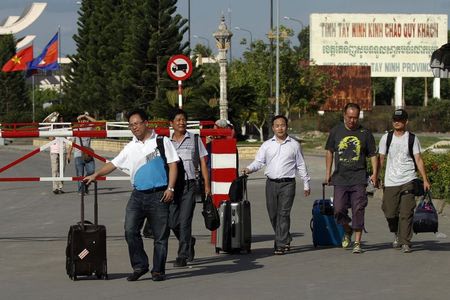
Chinese nationals queuing to leave Vietnam. photo from www.newslocker.com

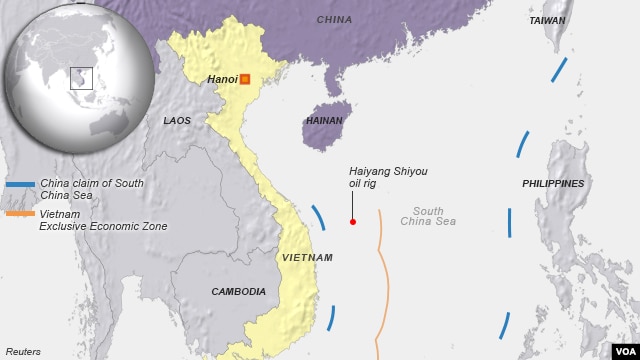
The oil rig in dispute

Click on image for full picture
The oil rig placed by China renews the conflicting claims of the two countries, as well as many other Southeast Asian nations resisting the broader Chinese assertion. Graphic from www.voanews.com

China was not messing around when placing its oil rig. The rig is a regular platform, and Chinese military warships or some version aggressively went after Vietnamese vessels with water cannon.

Click on image for full picture
A Chinese coast guard vessel protecting mammoth oil platform in the background. Photo from www.cctv-america.com

Click on image for full picture
Chinese vessel using water cannon on Vietnamese ship with a Chinese coast guard ship in the background. Photo from AP

From here on out ...

Teatree doesn't expect the Chinese to back down anytime soon in asserting its resource claim in the South China sea. Nor does he expect a meek acceptance of the violence against its citizens in Vietnam, in spite of the quick effort to evacuate them.

And while the Vietnamese have shown themselves to be a formidable foe - certainly with the French and then the US - this confrontation with the Chinese must certainly be viewed soberly.